 |
 |
 |
 |
 |
FISHERIES MANAGEMENT & LEGISLATIVE REPORT
by Tom Fote
FISHERIES MANAGEMENT & LEGISLATIVE REPORT
by Tom Fote
(from Jersey Coast Anglers Association (October 1999 Newsletter)
It is important that the Jersey Coast Anglers Association be able to keep in touch with the recreational community in a timely manner and be cost effective in doing it. The easiest way to accomplish this is by email. JCAA will be able to do this if we have your email address. We have invested in software and hardware to make this possible. The easiest way to be included in the list is to email your email address to tfote@jcaa.org In order to know to whom I am sending the email to I would like you to include some things in your email.
NAME
ADDRESS
TELPHONE
FAX
Fishing Club or Environmental Organization
What species is your primary concern?
Boat Angler or Surf Angler
Would you be interested in serving on one of JCAA's species committees or in any other
capacity?
Hopefully you will pass this on to your friends so they can also be added to JCAA Email list. Pass this around
I know this is a great month for fishing. But if you want to have fish for the future, you need to get involved now. From a number of articles in this newspaper, you can clearly see that there will be many public hearings this coming month. The results of these hearings will have a long-term impact on the resource. If you cannot attend these hearings, you can still write letters to the specific agencies or people involved. Your letters mean a great deal and can have a major positive impact. Ten dollars in postage is a small investment when you think about the long-term impact you can have. I will be at most of these hearings. If you are in attendance, please ask me any questions you may have. If you have difficulty finding any addresses, check our website or previous newspapers.
President Bill Clinton
1600 Pennsylvania Ave., Washington, D.C 20500
Fax 202-456-7929
Phone 202-456-1414
Dear President Bill Clinton:
I am writing this letter not only for the Jersey Coast Anglers Association but also for the New Jersey Federation of Sports’ Clubs. I am Legislative Chairman for both organizations. Together these two organizations represent 150,000 concerned sportsmen in New Jersey. Both organizations are extremely disappointed with the votes of the representatives of the U.S. Fish and Wildlife Service and the National Marine Fisheries Service.
At the September meeting of the MidAtlantic Council, the National Marine Fisheries Service voted for and spoke in favor of a motion that would transfer 3 million pounds of recreational quota on bluefish to the commercial sector, allowing commercial anglers a larger harvest. Despite the passage of this motion, there remained an additional amount of bluefish available to the recreational sector due to underfishing in previous years. The Northeast Director of the National Marine Fisheries Service, Patricia Kurkul, proceeded to speak against and vote against a motion that would allow this additional catch for the recreational sector. Had the National Marine Fisheries Service voted against both of these motions as a conservation measure, JCAA would have understood. But to continue to vote for the commercial sector and against recreational anglers makes no sense. This behavior is appalling and again indicates how biased the National Marine Fisheries Service is against the recreational angler.
At the Striped Bass Board meeting of the Atlantic States Marine Fisheries Commission on September 14, 1999, there were two motions that dealt with Striped Bass allocation. One motion resolved the problem by strictly following the existing FMP. The other motion was clearly pro-commercial and favored the producing areas over the entire Atlantic Coast. True to form, the National Marine Fisheries Service representative Ann Lang and the Fish and Wildlife Service representative Dr. Jamie Geiger voted for the biased motion and for the biased plan. In both instances they provided the deciding votes. Had they voted for both options, making both available for public hearing, we could have respected their position. Instead, they used their votes to favor the commercial sector and deny the public the right to speak to both plans. Once again, we find these actions intolerable.
I know that your administration, by executive orders, has told these agencies to work with the recreational community. To date, there has been no real change. While they try to talk a more recreational approach, their votes indicate that they have not changed in their basic approach. These two agencies should vote for resource protection. Instead, they continue to involve themselves in allocation issues, always in favor of commercial interests. The other members of the councils and commission are there to represent the competing interests and resolve allocation issues. In addition, public hearings are held to allow for input from both the recreational and commercial communities. The National Marine Fisheries Service and the Fish and Wildlife Service should restrict themselves to resource protection issues. We need for you to tell them, in the clearest and firmest manner, that they must stop interfering in allocation decisions.
While I represent the 150,000 members of JCAA and the NJ Federation of Sportsmen's Clubs, there are millions of recreational anglers along the Atlantic Coast who are furious with both of these agencies. We need your help.
Cc: Vice-President Al Gore, Secretary of Commerce William Daley, Secretary of Interior Bruce Babbitt, Director, US Fish & Wildlife Service Jamie Clark, Assistant Administrator for Fisheries, NMFS Penelope Dalton, Senator Lautenberg, Senator Torricelli, Congressman Andrews, Congressman LoBiondo, Congressman Saxton, Congressman Smith, Roukema, Congressman Pallone, Congressman Franks, Congressman Rothman, Congressman Payne, Congressman Frelinghuysen, Congressman Pappas, Congressman Menendez,
Hon. Bruce Babbitt, Secretary, Dept. of the Interior
1849 C St. NW,
Washington, DC 20240
PH: 202-208-7351 FAX 202- 2085048
William Daley, Secretary of Commerce,
Department of Commerce
14th and Constitution, NW, Room 35858
Washington, DC 20230,
PH 202-482-2112 FAX 202-482-4576
Hon. Terry D. Garcia,
Assistant Secretary for Oceans and Atmosphere,
NOAA, 14th 7 Constitution Ave. NW,
Washington DC 20230;
PH: 202-482-3567 FAX 202-482-6318
Penelope Dalton
Assistant Administrator for Fisheries, NMFS,
1315 East-West Highway,
Silver Spring, MD 20910;
PH: 301-713-2239 FAX: 301-713/2258
Jamie Clark, Director,
US Fish & Wildlife Service,
1849 C St. NW,
Washington DC 20240
PH 202-208-4717 FAX 202-208-6965
George Frampton
Assistant Secretary of Fish, Wildlife & Parks
Department of the Interior
1849 C St., NW, Room 3156
Washington, DC 20240
PH 202-208-4416 FAX: 202-208-4684
Since New Jersey has two producing areas, JCAA has always favored a plan that would be fair and equitable to all of our anglers. We believe that baseline should be raised from 20 to 24 inches in the producing areas. This would produce a large savings on smaller fish. Maryland has always opposed a large size limit, saying they have only small fish. The latest statistics show that with the exception of Massachusetts, Maryland is the largest harvester of 28 inch or larger fish. We never believed this argument, now we have statistics to show how wrong they are. The argument often made by Chesapeake Bay administrators is that they are way below their target mortality rate. The only reason they can make this claim is that they have the exclusive right to the 18 - 24 inch fish. If any other area would be allowed to participate in that size fishery, they would be way over the mortality rate. Maryland frequently has the support of Delaware and New York in their selfish effort to promote a small size fishery in the producing areas for their own state's commercial interests, while ignoring their coastal anglers. We are not picking on the Chesapeake Bay. We are simply looking for a way to manage both of our producing areas in a way that is fair to all anglers.
At the public hearing, you need to support plans that start protecting Striped Bass at four years, not at eight years. As Brad pointed out, the only way to get big fish is to protect little fish. Any plan that starts the protection at the eight-year level, relies entirely on reductions along the coast. In addition, only 5% of the fish ever reach the eight-year level. Conservation needs to begin earlier and be spread across the age classes. This would result in a fairer distribution of the conservation between the bays and the coast.
State of the Striper by Brad Burns 9/99 Over the last five or six years many striper fishermen have noticed a steady downward trend in the quality of their angling. In most areas there are fewer and fewer stripers of all sizes larger than 20 inches. Each spring - up until 1999 - the coast has seen big numbers of small bass. These fish return south in the fall, but when they swim north the following spring - after their first season as legal sized fish in the Chesapeake Bay fishery - there are one H of a lot less of them. This became really apparent to me a few years back when Maine instituted a 20 through 26-inch slot limit. Some days in September you'd have to wade through a dozen or more 18 to 19-inch fish to find one that was over 20 inches long.What exactly is happening? Why isn't the annual abundance of peewee stripers blossoming into tons of mid and high 20-inch sized schoolies, and why aren't we seeing the constantly expanding number of 40-inch and larger stripers that we were promised five or six years ago? Clearly there are too many small bass being caught, but by who? And, if we want to see more mid-sized and large stripers, just how many is too many? Finally, does anyone really know these answers, or do we rely too much on science that is admittedly quite imprecise?
The straight face test does make it easy to point the finger towards the overfishers of small stripers. The vaunted 1993 year class that produced zillions of tiny bass along the coast in 95,96, and 97, and now should be showing us big numbers of mid 20-inch fish, has been reduced - according to the scientists - to just an average year class. Wow! That took some doing, the 1993 year-class was the biggest ever recorded. But those fish never lived to reach the 28-inch legal size on most of the coast. Clearly the 1993 year-class was harvested far too heavily in Chesapeake Bay. Since they weren't legal anywhere else there can be no other plausible conclusion.
And why aren't we seeing a constantly larger supply of 40-inch stripers? They've got to be 28 inches first, don't they? Naturally, of the few making it to 28 inches, far fewer will ever see 40 inches let alone 50 pounds.
One of the biggest culprits in the striped bass story is the dysfunctional allocation scheme that determines the harvest of these fish. As the striper recovered a complicated concept called split reference points became a cornerstone of the plan. Under this concept anglers everywhere get to harvest legal sized stripers at the same mortality level. The difference is that along the coast the legal size is 28 inches - the coastal reference point - and in the Bay it's only 20 inches - the Bay's reference point. Coastal anglers make up 80% of striper anglers, yet they only get to keep fish from the 20% of the legal-sized striper population that is larger than 28 inches in length. The 20% of the anglers that fish in Chesapeake Bay and several smaller striper nursery areas along the coast are able to take their catch from the 80% of the legal-sized striper population that is between 20 and 28 inches in length. The Bay area anglers are also allowed to fish on the fish larger than 28 inches. Tom Fote calls this double dipping.
Why, you ask, would the Atlantic States Marine Fisheries Commission institute such a plan? Like a lot of things it probably sounded better than it has worked out to be. And it didn't happen without a fight. Some of the coastal activists fought hard for an equal reference point - these fish are a public resource are they not? At the ASMFC, though, the loudest squeakiest commercial wheel gets the grease. The Bay area state directors fought zealously for the split reference point knowing that it would provide their watermen with the bulk of the striper harvest, and it has. The coastal states apparently assumed that there would be plenty of 28-inch and larger fish for their anglers, and they bowed to the Bay's wishes.
Now the inequities inherent in the split reference point plan are becoming apparent. Bay area anglers have a long season under which they're allowed to take home a couple of 18-inch or larger fish each day - and with no upper size limit. In fact Maryland has not only the largest take of small stripers, but it also is the number two harvester of 28-inch and larger fish on the whole coast. On the other hand all but a tiny fraction of all coastal anglers ever get to keep even one striper for the entire season!
The ASMFC scientists now claim that fish larger than 28 inches are severely overfished, and that we must reduce the harvest of 28-inch and larger stripers by 28%. This translates to a reduction to one fish at 28 inches - which yields only a 6% reduction in mortality since large coastal harvesters like Massachusetts and New York were already at one fish rather than the two previously allowed by the plan - and then a further reduction of 22%! This reduction can only come by increasing the size limit to well above 30 inches, or by shortening the season during which anglers are allowed to keep fish. Meanwhile, since the smaller fish reserved for Bay area anglers are not considered overfished, these fishermen could continue harvesting two stripers a day as small as 18 inches in size.
Several options for changes in the year 2000 regulations are headed to public hearing in October. One option would raise both reference points to 22 and 30 inches for the bay and coast respectively. The 22% reduction beyond going to one fish is another. It's hard to say what's likely to be adopted. I attended the last ASMFC meeting in September, and there's plenty of tension and frustration surrounding this entire issue.
Whatever the selection is, it's just a fix for next year; something far more comprehensive is envisioned for 2001. If we want a return to the days when the striper population contained a good level of large fish we must do something to reduce mortality on smaller stripers as well as larger stripers. For one thing, it is almost guaranteed that mortality on the small fish is underestimated. The scientists so much as admit this by telling us that landings in commercial fisheries tend to be understated. As one scientist at the recent ASMFC meeting said, "commercial interests don't usually over-report landings - why would they." Additionally, since there is no official basis for estimating the commercial black market for stripers, there is no estimate included in the population models. A recent court case in New Jersey had one commercial fisherman admitting to 100,000 pounds of fish taken illegally and sold within a three-month period. The commercial bycatch is also suspected to be vastly underestimated. All of these factors could make the actual mortality on small stripers much higher than it's currently estimated to be.
It was suggested recently at an ASMFC technical committee meeting that the reference points be equalized on the Bay and the coast at 24 inches. That option was immediately considered impossible to implement since it would require the Bay area fisheries to cut their catch by in excess of 50%. None-the-less, I can't see any reason why it wouldn't be the fair thing to do. After all, the fact that big cuts must be made in a quota that should never have been granted to begin with is no excuse for not doing the right thing now.
Arguments have been made that since the fish are born in the Bay and nursed there that the Bay should get a preferential share of this resource. In the words of one ASMFC scientist that I spoke with, "this is poor concept, and one that discriminates against coastal residents. This is a cohort of fish that happens to be born in one place, but that moves freely around the East Coast feeding as it goes." Two points that seem to be lost in the ASMFC debates are that smaller stripers are the traditional striper harvest of the public on the coast just as they are in the Bay, and that many striper anglers want to keep an occasional small striper to eat. The rights of these fishermen have been, and still are, being ignored by many states on the ASMFC.
Brad Burns has a history of involvement in Striped Bass management, serving on the original Striped Bass Advisory Board in 1979. Brad is from Maine and is a lifelong Striped Bass fisherman and protector. He worked for the restocking of the Kennebec River and continues to fight for its protection. He was instrumental in beginning the Maine and Massachusetts CCA and continues for work with both organizations as well as the national CCA. Brad is the author of two books, one on fly fishing for striped bass and one on fly fishing along the East coast. He has written many articles, including several for the JCAA newspaper.
Summary of Striped Bass Management Board September 14, 1999 BY ASMFCThe Striped Bass Management Board met on September 14, 1999 in Providence, Rhode Island. The goal of the meeting was to develop management options to reduce fishing mortality on striped bass to levels that arc consistent with the objectives of the management plan. The Chair of the Technical Committee presented the Committee's analysis on options for reducing fishing mortality- Based on this analysis the Management Board developed three options to be included in the Public Hearing Document. The Board also included an option on implementing the reductions in fishing mortality entirely in year 2000 or pahsing-in the reductions during year 2000 and 200 1. The details of the options are captured in the motions below.
The Management Board reviewed the schedule for the remainder of 1999 to implement the changes for year 2000. The final issue that the Management Board addressed was the funding for the New York Ocean Haul Seine Survey. The Board Chair agreed to draft a letter to the National Marine Fisheries Service to u rge the continued funding of the survey. The Board agreed that this survey was an important index that is used in the annual striped bass stock assessment.
Move to implement a 28% reduction on age 8 and older striped bass in I or 2 years as a baseline for developing options to be included in a Public Hearing Document.
Motion made by Mr. Augustine and seconded by Mr. Abbott Motion passed; 8 votes in favor, 5 votes against, and I null vote
Move to make a substitute motion that the Board develop options based on achieving F~0.31 in year 2000 for fully recruited striped bass (age 4 and older).
Motion made by Mr. Fote and seconded by Mr. Abbott Motion failed; 5 votes in favor, 8 votes against, and I null vote
Move that an option be included in the Public Hearing Document where all coastal fisheries will implement a one-fish recreational creel limit and all states develop a program to achieve a 22% reduction on age 8 and older striped bass.
Motion made by Mr. Colvin and seconded by Mr. Coates Motion passed unanimously
Move that an option by included in the Public Hearing Document where all state/jurisdictions will develop a management program that achieves a 28% reduction on age 8 and older striped bass.
Motion made by Mr. Fote and seconded by Mr. Flagg Motion passed; 10 votes in favor, 4 votes against
Move that an option be included in the Public Hearing Document that increases the minimum size in producer and coastal areas by two inches. These increases in size limits will result in an increase in the reference points that will meet tile objectives of the plan.
Motion made by Mr. Colvin and seconded by Mr. Pate Motion passed; 8 votes in favor, 6 votes against
Move that an option be included in the Public Hearing Document that reduces all striped bass fisheries with a direct quota by 28%. This option would affect commercial fisheries and the Chesapeake Bay Trophy fishery
Motion made by Mr. Pate and seconded by Mr. Abbott Motion failed; 3 votes in favor, 11 votes against
The NJ Senate voted on Menhaden Bill (S722/A1827) on June 21 and we are still waiting for the assembly to act. This bill would get the large Reduction Boats out of state waters. This bill now has to go to Assembly for passage. This is our best chance to get something done with regard to Menhaden this year. You need to start putting pressure on the NJ Assembly to get this bill moved. We can accomplish passage of this bill this legislative this session and it effects the entire New Jersey Coast. The key people to move this bill are Assembly Speaker Jack Collins and Assemblyman John Gibson, chair of the Natural Resources and Agriculture Committee. The Natural Resources and Agriculture Committee is the next step for this bill. You need to call, write or fax each of these assembly representatives and let them know you want this bill (S722/A1827) posted as soon as possible. You should also remind them that this is an assembly election year and you are concerned about their actions. In addition, you need to contact you local assemblymen and women, asking for their help to get this bill posted and their vote for this important legislation.
Speaker Jack Collins R
Suite C
63 East Ave
Woodstown NJ 08098-1499
PHONE (856) 769-3633 FAX (856) 769-0049
AsmCollins@njleg.state.nj.us
John C. Gibson, - Chair R
Legislative District 1
2087 South Shore Rd., Seaville, NJ 08230
PHONE (609) 624-1222 FAX (609) 624-0244
asm.jcgibson@worldnet.att.net
Connie Myers, Vice-Chair R
Legislative District 23
124 W. Washington Ave., Washington, NJ 07882
PHONE (908) 835-1202 FAX (908) 835-1205
asw.cmyers@worldnet.att.net
Larry Chatzidakis, R
Legislative District 8
Suite 103, 3000 Midlantic Drive, Mount Laurel, NJ 08054
PHONE NUMBER: (609) 234-8080
FAX NUMBER (609) 234-3990
asm.lchatzidakis@worldnet.att.net
Clare M. Farragher, R
Legislative District 12
40 Broad Street, Broad Street Professional Plaza,
Suite 4, Freehold, NJ 07728
PHONE NUMBER: (732) 462-9009
FAX NUMBER (732) 462-5467
asw.cmfarragher@worldnet.att.net
Scott E. Garrett R
Legislative District 24
61 Spring St., 3rd Floor, Newton, NJ 07860
PHONE NUMBER: (973) 579-7585
FAX NUMBER (973) 579-4902
asm.esgarrett@worldnet.att.net
Barbara Buono D
Legislative District 18
1967 Rt. 27, Suite 20, Edison, NJ 08817
PHONE NUMBER: (732) 287-5609
FAX (732) 287-5640
asw.bbuono@worldnet.att.net
Herbert Conaway D
Legislative District 7
Delran Professional Center
8008 Route 130 North
Delran, NJ 08035
PHONE NUMBER: (609) 461-3997
FAX (609) 461-3823
asm.hcconaway@worldnet.att.net
On September 7,1999 a list of new rules and amendments was published in the New Jersey Register. A public hearing on this proposal will be held on September 22, 1999 7:00pm at Stockton State College. There is also an open comment period that will run through October 7, 1999.
There are several points of interest for recreational anglers.
The protocol is that these changes are first published in the REGISTER, then go to public hearing, and finally go before the New Jersey Marine Fisheries Council for a vote. If these are issues that you feel important, then it is vital for you to attend the public hearing. However, if you can not attend the hearing, you should send your written comments to.
&
This is a great opportunity to get involved in the process of Fisheries management. The menhaden provision is what has been talked about for years and the Division included it in this document to alleviate disputes in Raritan and Sandy Hook Bays.
This document will go to the New Jersey Marine Fisheries Council for its recommendation on October 28, 1999. If there is no input from anglers on any of the topics, then the council can pick and choose which articles to recommend. Please make sure that you make yourself heard on this issue.
Hope to see you at the Bunker Hearings! This is our chance to be heard!
There are two hearings scheduled in September at Stockton College, Jimmie Leeds Road, Pomena. For information, contact Bruce Halgren, 609-748-2020.
Sept. 21 - This hearing will be held at 7:00 pm in A-Wing Lecture Hall. This will provide an opportunity to submit comments for the development of a new Fisheries Management Plan for Menhaden.
Sept. 22 - This hearing will also be held at 7:00 pm in A-Wing Lecture Hall. This is being sponsored by the New Jersey Division of Fish and Game for consideration of changing the bait limits to 6/10 of a mile.
It would be great if each club could have representation at each meeting. The meeting on the 22nd is where it is critical that we show up in large numbers to support the N.J. Division of Fish & Game proposal to change the limits in Raritan and Sandy Hook Bays. You can be sure the Bait industry will show up in force. The Hi Mar Club, Sandy Hook Bay Anglers, and Bay Shore Fly Rodders are chartering a bus which will depart from the Atlantic Highlands Municipal Marina at 5:00 pm. Contact Jim Sullivan at 732-787-2349, or Rich Kress at 732-358-3086. I would like to suggest that other clubs in close proximity to each other try the same approach. If we are successful, the State could change the regulations this year!
I’ve listed below the Menhaden Project’s position on this proposal:
Menhaden Project Position On The Proposal To Move the Bait Purse Seine Limit From 0.3 Miles to 0.6 Miles in Raritan and Sandy Hook Bays:
This is a step in the right direction, but it does not go far enough.
Sandy Hook and Raritan Bays are key nursery areas for both Menhaden and Predator fishes and should be closed to all purse seining.
Sandy Hook and Raritan Bay present a sensitive environment which, due to its shallow nature, is disrupted by seining.
An appropriate balance of Menhaden and Predator species is important to the ecological health of these Bays. The heavy fishing in these confined areas disrupts that balance and puts the health of the Bays at risk.
The increasing pressure of the Bait industry in these in-shore waters deprives the Recreational community of a fair share of the benefit from this resource.
Gear conflicts between the Bait and Recreational interests continue to be a problem.
The current 0.3 of a mile is continually violated and not enforced. The 0.6 mile provides no more protection, since it too cannot be enforced. The solution is a ban on netting in the Bay, which can be easily verified and enforced.
The State should expand the current proposal to eliminate purse seining for purposes of reduction in all State waters. This will more than supplement the Bait industry’s efforts to harvest bait.
The elimination of purse seining in Sandy Hook and Raritan Bay will have minimal impact on the New Jersey Bait industry. Sandy Hook and Raritan Bay are contained in Zone 1, which historically provides approximately 10% to 20% of the total Bait harvest. The industry alleges about half of this comes from Sandy Hook and Raritan Bay.
We look forward to seeing you there!
Mark your calendar. On September 21st and 22nd there will be hearings held at Stockton College on Menhaden. On September 21st the Atlantic States Marine Fisheries Commission will chair a hearing on their Public Information Document on the fisheries management plan for Menhaden. The meeting will begin at 7:00 in the A-Wing Lecture Hall. The complete address for Stockton College is Jimmie Leeds Road, Pomona. This hearing offers us an opportunity to discuss the management of Menhaden coast-wide. If the reforms contained in the Public Information Document are implemented we will see better management of Menhaden along the entire coast. The JCAA Menhaden Committee will have a completed a position paper available prior to the hearing and will post it on JCAA's website. The PID is posted at our website or you can contact the ASMFC (Jeanette Braxton) at 202-289-6400 ext. 333.
1The NJ Division of Fish and Game is sponsoring the hearing on a Multi-Species Regulatory Proposal on September 22nd. The time and place are the same. If you can only attend one of these meetings, it is crucial that you are present on September 22nd. Some changes are to bring New Jersey in line with other regulatory agencies. Others, however, are important changes in how New Jersey manages these species. Listed for discussion are proposed changed in regulations for striped bass, lobster, weakfish, winter flounder, summer flounder, Atlantic herring, scup, crab, shad, and purse seining for menhaden in Raritan Bay. This is important. Changing the regulations in Raritan Bay was eliminated in the legislation currently under consideration in the New Jersey Legislature. This is an opportunity to work on this problem without going through the time consuming legislative process. I credit the Division of Fish and Game for taking on this difficult issue. Under the proposed changes, the distance allowed purse seiners would go from .3 mile to .6 mile. I attended the NJ Marine Fisheries Council Meeting where this was announced. The purse seiners are already making inaccurate claims about the negative impact of these changes. At a recent legislative hearing on Menhaden, we were outnumbered 15:1. Many recreational anglers complained that hearings held during the day are impossible to attend and that they needed more notice. This is your chance to speak up. I will guarantee there will be more than 100 commercial fishermen in attendance. If we don’t turn out in large numbers, these changes will not happen. The Division of Fish and Game needs our overwhelming support. Those who feel .6 mile is not far enough from the shore show up and say so. It does you no good to sit home, in a tackle store or club meeting and complain. If you show up at the public hearing, you can make this happen. You can get a copy of the field documents from the Office of Administrative Law, 9 Quakerbridge Plaza, PO Box 049, Trenton, 08625-0049. For copying fees you must call 609-588-6613. You need NJA.C. 7:25-14.1, 14.2, 14.4, 14.5, 14.7, 14.10, 14.16, 14.17, 14.18, 18.1, 18.2, 18.14, and 22.3. JCAA will attempt to post the applicable amendments at our website prior to the meeting. For additional information, call Bruce Halgren at 609-748-2020. I will see you at the hearing.
Thomas P. Fote
Legislative Chairman JCAA & NJSFSC
22 Cruiser Court, Toms River NJ, 08753
732-270-9102 Fax 732-506-6409
Email tfote@jcaa.org
Atlantic States Marine Fisheries Commission October 31-November 4, 1999 Mystic, Connecticut preliminary schedule
[NOTE: This is the initial preliminary agenda and is subject to change]
6:00 p.m. - 8:00 p.m. Legislative Committee
Review of 106th Congressional Legislation/develop positions; Federal Commerce and Interior Department Appropriations for Fiscal Year 2000; Sport Fish Restoration Fund (Wallop/Breaux) accounting issue; update on OCS Reinvestment proposals; enacted public laws of the 106th Congress
8:00 a.m. - 10:00 a.m. Tautog Management Board
Review public comments on Addendum 2; approve Addendum 2 to the FMP; discuss Rhode Island compliance issue; update on the stock assessment
10:00 a.m. - Noon Atlantic Menhaden M. Board
Review public hearing comments; discuss management measures for Amendment 1; review/approve FMP review
12:30 p.m.-3:30 p.m. American Lobster M. B.
Review state plans for implementing Addendum 1; discuss potential state/federal agreements in implementing Addendum1; discuss potential for a Commission-sponsored trap tag contract; review recommendations from the historical participation working group
12:30 p.m. - 6:00 p.m. M. and Science Committee
3:30 p.m. - 6:00 p.m. Habitat Committee
Discuss program update; program planning for FY 2000; Gear Impacts to SAV
3:30 p.m. - 6:00 p.m. Advisory Committee
Review results of the Advisory Questionnaire; finalize recommendations for action to the ISFMP Policy Board
6:00 p.m. - 8:00 p.m. Reception (Mystic Aquarium)
8:30 a.m. - Noon Striped Bass M. Board
Approve state management plans for year 2000; discuss the schedule for the next amendment or addendum
8:30 a.m. - Noon SAV Workshop
8:30 a.m. - 5:00 p.m. Law Enforcement Committee
Review implementation of 1999 recommendations; review and make recommendations for FMPs for 2000
1:00 p.m. - 3:00 p.m. American Eel M. Board
Review revised FMP as approved on August 3, 1999; discuss deadlines for states to submit deminimis status requests; discuss implementation dates for FMP; approve final FMP; discuss action by board: recommendation to ISFMP Policy Board for adoption of FMP
1:00 p.m. - 5:00 p.m. M. and Science Committee (continued)
3:00 p.m. - 5:00 p.m. Shad and River Herring M B
Discuss PRT Report (annual reports and 1999 FMP review) and Technical Committee Report (Fishing Recovery Plan; issues raised at August 4, 1999, Meeting); approve State Fishing Recovery Plans
7:00 p.m. - 10:00 p.m. Dinner
Wednesday, November 3, 19997:30 a.m. - 9:00 a.m. Technical Workshop for Commissioners
9:00 a.m. - 10:30 a.m. Legislators and Governors' Appointees
Review of AOC-recommended changes to the ISFMP Charter; brainstorming of topics for next technical workshop; election of Legislator Officers; Election of Governor's Appointee Officers
10:30 a.m. - 12:30 p.m.Horseshoe Crab Management Board
Discuss Advisory Panel and Technical Committee reports; update on implementation of Maine and Rhode Island State Management proposals and development of Year 2000 coastal cap on the commercial bait fishery for horseshoe crabs
1:00 p.m. - 2:15 p.m. Captain David H. Hart Award Luncheon
2:30 p.m. - 5:00 p.m. Bluefish Symposium
8:00 p.m. - 9:30 p.m. Administrative Oversight Committee
7:30 a.m. - 10:00 a.m. ISFMP Policy Board
Review/approve American Eel FMP as recommended by the American Eel Management Board; Review/approve Charter changes proposed by the Administrative Oversight Committee (AOC); Update by Northern Shrimp Section; reports and recommendations of the Habitat Committee, Law Enforcement Committee, Management and Science Committee and Advisory Committee; review progress under the Strategic Plan (1999); review, prioritize, and approve planned work under the 2000 Strategic Plan
10:00 a.m. - Noon Executive Committee
Noon - 1:30 p.m. Business Session and Lunch
1:30 p.m. - 5:30 p.m. ACCSP Coordinating Council

Thanks to all the public outrage, the US Army Corps will hold a public hearing on the proposal to ocean-dump the pollutant-laden muck from New York's, Castle Astoria Terminals. The hearing will be held at Fort Monmouth, NJ, October 20, 1999 in the Theater. The times are from 3 to 5 p.m. and 7 p.m. to closing. The Theater holds 900.
The proposal is to dump 90,000 tons of mud from the Castle Oil's barging terminals, located in the East River, Queens, New York. The facility is located in the industrial area of Bowery Bay and they are next door to the Bowery Bay Sewage Treatment Plant. The muck is 85% fluff (light weight clays and silts that waft away when stirred up) and is loaded with petroleum, PCB's and sewage. There are over 170 sewer overflow points in the general area and, since the mud was last tested two and one-half years ago, there have also been several fuel spills. However, the US Environmental Protection Agency and Corps of Engineers determined that this black gooey muck is clean and can be used to clean-up the ocean.
A Promise Broken?
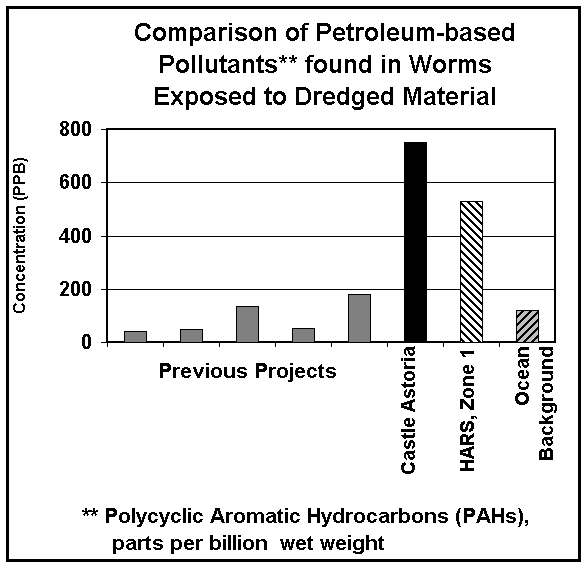
You will recall that in 1996 Vice President Al Gore agreed to end ocean dumping of contaminated muck and that the ocean would be cleaned-up to fix the damage done. On September 1, 1997, ocean dumping was ended off the New Jersey shore. EPA and the Corps were required to place only uncontaminated material into the ocean after September 1, 1997, to clean-up a toxic area of the ocean located a mere 3.5 miles off the Jersey Shore, known as the "toxic stain" or the Historic Area Remediation Site (HARS). The Castle Oil dredged muck has levels of toxins (especially PCBs and petroleum hydrocarbons) that will not clean-up this toxic stain. The graph shows how levels of petroleum-hydrocarbons from Castle Oil muck compare to levels from previous remediation projects, the toxic stain "HARS, Zone 1", and the cleaner ocean background that surrounds the toxic stain.
It gets worse: Using the EPA’s definition of clean, the toxic stain in the ocean will become much worse than it is today—beginning with this mud from a highly industrialized, oil-spill-riddled, sewage stained area in Bowery Bay. The EPA must change its definition of clean and uncontaminated. Right now, for example, the notorious chemical PCB is considered highly elevated in the toxic stain. EPA’s current definition of "clean" and "uncontaminated" for dredged materials allows PCBs to get two-times higher than those elevated levels in the toxic stain.
If the Castle Oil application is permitted, it will set a precedent to allow contaminated material back into the ocean and for renewed ocean dumping off the New Jersey shore. This will also set-back all the advances that New Jersey has made in developing and implementing dredged material treatment alternatives.
The ocean needs you on October 20, 1999 to oppose the application by Castle Oil. Attend this public hearing, bring family, students, and friends. Check-out the action alert at Clean Ocean Action's website www.CleanOceanAction.org for more information about this proposal.
Directions: Take Exit 105 off the Garden State Parkway. At third traffic light make a left onto Wycoff Road and follow to second light. Turn left onto Route 35 north. Follow approximately 1.5 miles. The entrance to Fort Monmouth is on your right. Turn right into the Fort. The Theater is down a few hundred yards on your left.
|
|
|
|
|