Fisheries Management & Legislative Report
Contents:
As Paul Haertel stated in the article just above, at the General Meeting on Tuesday night, JCAA will be voting on a position on Striped Bass. Once that position is voted on, we will get the press release out to the clubs so they can write letters to ASMFC. There are numerous ways to submit public comments as the article indicates before the deadline this Friday.
Over the years I have written about the problems with balloon releases. I hate to mention how many balloons I have seen floating in the water. There is an article below from a farmer telling how he finds the balloons all over his fields. We have known for a long time that the balloons kill all types of marine life, but we have not been able to get the NJ Legislature to take action. I will be recommending to JCAA that we get a sponsor to a bill in the next legislative session to ban balloon releases. In addition, any store that sells helium balloons must attach an advisory stating they should not be released and include information about the damage done to wildlife. We know plastics are not only dangerous to marine life but to humans as well when they disintegrate and leave their residue behind. We will be reaching out all the other NGOs to make this a high priority. This is long overdue. Please read the article.
Curtis Fisher has been reaching out to me to get involved in legislation that will tax the polluters from the oil companies that have known they were contributing to climate change. This money will go for a number of items that will include fisheries research and habitat protection. It will also be funded to protect against future Sandys. The federal government has been cutting back on FEMA and funding for climate resilience projects. EPA and NOAA had to eliminate any references to climate change in any project. I am not sure there will be any money for clean-up or rebuilding after another Sandy. For these reasons I am supporting the legislation, and I want JCAA to get on board. I have been doing this through Clean Water Action and other groups, but it would be good to JCAA’s name to this legislation. We could also ask NJ State Federation of Sportsmens Clubs and NJ Outdoor Alliance. We need the funding to mitigate the impact on all of our natural resources. Please read fact sheet #1 and fact sheet #2 provided by Curtis Fisher. Curtis has volunteered to any group that has questions.
The ASMFC Annual meeting will be held at the Hyatt Place, Dewey Beach, Delaware, October 27 – 30. I will go to Dewey Beach to see what happens with striped bass and attend other meetings. If I attend the meetings in person, I will have an opportunity to talk to commissioners from other states.
The Commission is not following their procedures as we set them up under the Atlantic Coast Conservation Act. I understand that once a document goes to public hearing, the Commission feels there is no need to allow public comments. The Addendum to the Striped Bass Act did not go out to scoping meeting for the public to comment on what should be in the document. That is not what Jerry Schill (North Carolina Fishermen’s Association), Larry Simms (Maryland’s Waterman’s Association) and JCAA agreed to when the Commission asked for our support in passing the Atlantic Coast Conservation Act back in the mid-nineties. The Commission committed to an open process for the public, allowing comments before and during the process of finalizing documents. At the Striped Bass Board meeting, when they were setting up the document, they should have allowed ample time for the public to voice concerns and provide information. They should have scheduled the meeting for a full day instead of the 5 hours which they exceeded quickly due to the Commissioners’ discussion.
During the meeting, individual Commissioners spoke 10 times more than all the public was able to speak in the 4 minutes allocated. The Commission needs to return to the fundamentals by reaching out to both the recreational and commercial communities when considering an addendum that will have a huge economic impact on the fishing community. Of course, before the document that would be sent out to public hearing, ASMFC should have allowed fishermen to comment on the negative impacts.
I attended the NJ Advisor’s Meeting and the NJ Public Hearing. There was only one club supporting any option other than status quo. We will see what happens after ASMFC votes. Maybe this is a time to take the same action that we did on summer flounder years ago and get our state to go out of compliance. There is no way ASMFC can prove that these measures will do anything to improve the spawning of striped bass in Chesapeake Bay. As we have stated numerous times, the size of spawning stock biomass is not the problem. We are at a level that can produce the largest young of the year index ever. Let’s deal with the real problems, the environmental issues. Let’s deal with pollution in the spawning areas and the endocrine disruptors, the heating of the Chesapeake Bay waters and the invasive species that were introduced there. Let’s not pick on the commercial and recreational fishing industry that did not cause the real problem.
The Atlantic States Marine Fisheries Commission’s 83rd Annual Meeting will be held October 27-30, 2025, at Hyatt Place Dewey Beach, Delaware. Here is a link to ASMFC’s page on all meeting information. Further down the page or at this link you can find the preliminary meeting agenda.
The agenda is subject to change. Bulleted items represent the anticipated major issues to be discussed or acted upon at the meeting. The final agenda will include additional items and may revise the bulleted items provided below. The agenda reflects the current estimate of time required for scheduled Board meetings. The Commission may adjust this agenda in accordance with the actual duration of Board meetings. Interested parties should anticipate Boards starting earlier or later than indicated within the agenda.
Balloons that are Silently Ruining Farms
This man's New Jersey farm isn't the only place impacted by balloon littering. Reports suggest that balloons threaten marine life as well.
Balloons mean celebration. Be it a wedding ceremony, a birthday party, or a healing ritual, people hold on to these colorful, glossy balloons as long as it is necessary, and then they gently let them go. The balloons launch towards the sky, and the moment they arrive in the atmosphere, the pressure of the barreling winds causes them to burst and deflate. The resulting deflated plastic then plummets down on the ground, often falling into oceans and threatening wildlife. In a TikTok video, South Jersey farmer Timberline Farms vented out his frustration after noticing balloons repeatedly littering the grounds of his farm. “I could have accidentally eaten this,” he lamented in the caption.
About 71 percent of planet Earth is made up of water. So, when these balloons are released into the air, the probability that they will end up inside an ocean is quite high. Even when they end up in farms or grasslands, winds can easily blow them away and push them into the oceans. Longwood University reported the case of a juvenile green sea turtle that washed up on shore in Argentina. When doctors cut up its stomach, they found the plastic of balloons clinging to it. In 1985, a 15-foot-long sperm whale washed up on a New Jersey beach, with a balloon sticking inside its stomach.
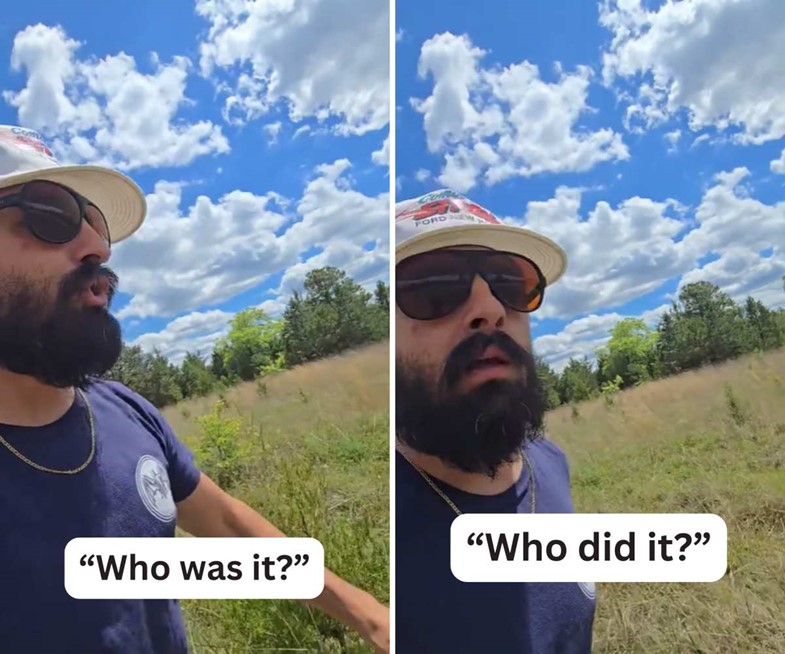 NJ farmer vents out frustration after noticing balloon litter in his farm (Cover Image Source: TikTok | @timberlinefarmsnj)
About 71 percent of planet Earth is made up of water. So, when these balloons are released into the air, the probability that they will end up inside an ocean is quite high. Even when they end up in farms or grasslands, winds can easily blow them away and push them into the oceans. Longwood University reported the case of a juvenile green sea turtle that washed up on shore in Argentina. When doctors cut up its stomach, they found the plastic of balloons clinging to it. In 1985, a 15-foot-long sperm whale washed up on a New Jersey beach, with a balloon sticking inside its stomach.
In September 1987, another case of a leatherback turtle came to light. Its dead body contained traces of plastic. The university explains that nowadays, incidents like these are not unusual. Oftentimes, when these balloons end up inside oceans, creatures like sea turtles, whales, and albatrosses mistake their shimmery plastic for jellyfish or seagrasses. Thinking it to be food, they gobble them up and end up dying from suffocation. The farmer from Timberline Farms called out on the viciousness of people who recklessly release these balloons.
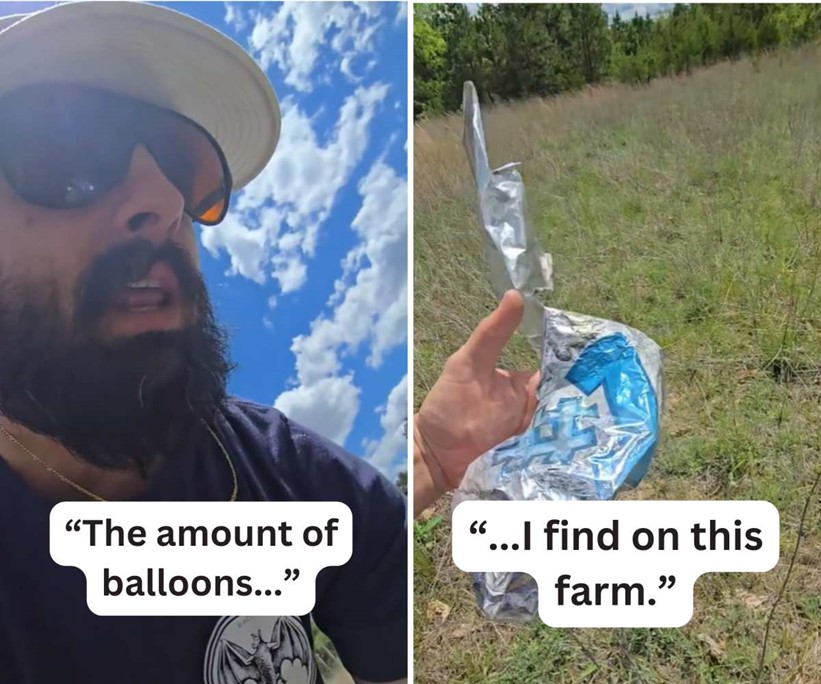
“Mad on. I swear to God, if I find out which one of you [...] is letting off balloons all helter skelter. The number of balloons that I find on this farm. Who was it? Who did it?” The bearded farmer said while walking around on a grassy patch of his farm. At one point, he focused the camera on the grass and picked up a crumpled piece of plastic, which turned out to be a deflated balloon. “This is for a 1-year-old's birthday. They ain't even gonna remember this. But I will,” he chuntered, before wrapping up the video.
 A group of people releasing pink balloons in the air (Representative Image Source: Getty Images | SDI Productions)
Viewers were left heartbroken by the video. Some of them expressed frustration about the matter of this ever-increasing balloon litter in New Jersey farmlands. “I know where it came from, all of them. They are from the Dollar General on the corner,” commented @smiley.@heather said, “Nothing pi**ed me off more than balloons being released.” It’s not just a moody disparaging of balloon littering that this farmer and the viewers expressed. Even scientists have presented evidence of how this littering problem can pose severe danger to the environment.
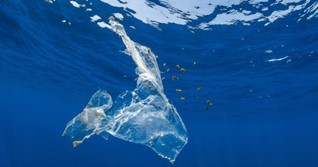 A piece of a plastic bag floating in the waters of the Indian Ocean. (Image Source: Getty Images | Wildestanimal)
A 2015 paper published in the journal Marine Policy documented evidence that balloons are among the “most dangerous types of pollution” for coastal wildlife, along with fishing gear and plastic bags. They get stuck in animals’ throats, and many lose their lives after getting entangled in their plastic. Ocean Conservancy also released a report in 2017, proclaiming that balloons are one of the “top deadly forms of litter,” including those that are advertised as “biodegradable.”
You can follow Timberline Farms on TikTok for food and farming-related videos at @timberlinefarmsnj
Link to original article.
Fact Sheet 1: Protecting & Restoring Fisheries & Wildlife 1
The Challenge:
- Flooding, heat waves, and other climate impacts are severely affecting New Jersey’s valuable fisheries and wildlife.
- State funding for fisheries and wildlife research, habitat protection, and restoration is urgently needed.
- Federal funding for many fisheries and wildlife research projects is at risk.
The Opportunity:
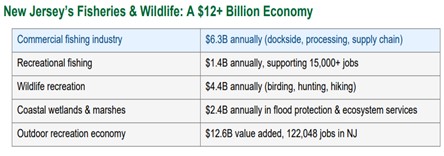
The New Jersey Climate Superfund Act (S-3545/A-4696) raises $50 billion from the world’s largest oil companies to fund urgently needed projects that protect New Jersey from flooding, heat waves, and other climate impacts. The proposed legislation prioritizes fisheries, wildlife, and natural resource projects:
Right now, NJ residents and businesses, including anglers and hunters, are paying 100% of the costs to repair and upgrade critical infrastructure and natural resource protection and resiliency efforts. The Act would shift a portion of these costs to the big oil companies. Leading economists, including a Nobel Prize winner, stated:
Fact Sheet 2: Make Jersey More Affordable, Safe & Resilient
Summary:
Some of the country’s leading economists, including a Nobel Prize winner, a former Chief Economist of the World Bank, and other experts on how government policies affect markets—have filed a brief on the economic consequences of the Climate Superfund Act in Vermont.
The New Jersey and Vermont “Climate Superfund Acts” both contain the central provision highlighted by the economists: “The Act imposes a one-time, retrospective payment on a small set of fossil fuel companies for their pro-rata share of greenhouse gas emissions from 1995 to 2024. These one-time assessments are classic “fixed costs.” Fixed costs based on past pollution do not increase future production costs.”
The economists’ key findings include:
-
No Gasoline or Oil Price Increases:
The Act will not shift costs to consumers by increasing the price of crude oil or the price of gasoline at the pump.” -
No Reduction in Production or Revenues:
“Nor will liability under the Act reduce firms’ energy production levels or impact government tax revenues.” -
Companies and Shareholders Will Absorb Costs:
“Because the payments required by the [Climate Superfund] are based on past conduct and do not affect incentives going forward, the companies and their shareholders will absorb these costs without causing economic harm to consumers or governments.” -
Economic Arguments Against the Climate Superfund Act “Are Implausible and Hyperbolic”:
“Our interest in this case is to inform the Court of the economic consequences of the Act so that the Court’s legal analysis can be based on an accurate picture of “commonsense economic realities,” rather than the government plaintiffs’ implausible and hyperbolic assertions of economic harm…”
The New Jersey Climate Superfund Act Imposes Fixed Costs for Past Conduct:
The Act’s one-time assessment is what the economists call a fixed cost:
- The Act’s cost to a company does not change based on future conduct or greenhouse gas emissions.”
- An oil company’s liability, for example, remains the same whether, in the future, the company produces 0, 1, or 1,000,000 barrels of oil.”
- The Act therefore does not impact a firm’s marginal cost of production, which, again, is the amount of money it costs the firm to produce one additional barrel of oil, ton of coal, or cubic foot of natural gas.”
- The Act’s economic effects are fundamentally different from interventions that concern future emissions, such as a carbon tax or lawsuits asserting prospective tort liability.”
The economists note: The assessment also does not affect “neither the marginal cost of production nor the marginal revenue received and thus does not affect either demand or supply.”
New Jersey Unique and Competitive Gasoline Market & Laws Protect Consumers:
New Jersey’s highly competitive gas market and large number of independent gas stations protect consumers from price hikes at the pump. Many major “branded” gas stations (e.g., Exxon) are not owned by the oil companies whose names they carry. They have no legal obligation—and often no practice—of buying gasoline from their branded company, sourcing instead from independents at the lowest prices. Independent gas stations have no such restraints, push prices lower, and ensure the gasoline market is not controlled by big oil.
Federal and state laws also prohibit collusion and price-fixing. The Climate Superfund assessments imposed on big oil companies will range from zero to tens of millions of dollars annually per company. While companies with large assessments might want to raise prices to recover costs, they will be competing against companies with smaller assessments or none at all.
Big oil companies strongly oppose the Climate Superfund Act because they know they cannot pass on these costs to consumers. By contrast, they have historically supported carbon pricing and gasoline tax proposals, which do allow costs to be shifted to the public.
Economists’ Background
The background of the nine economists includes: a Nobel Prize winner, authors and professors from leading universities and institutes. All have served in prestigious positions beyond their academic roles, including the Chairman of the White House Council of Economic Advisers, Chief Economist and Senior Vice President of the World Bank, Senior Economist for International Finance at the President’s Council of Economic Advisers.