Fisheries Management & Legislative Report
Contents:
I think it is important that you have information about what we are dealing with. Because Virginia stocked blue catfish back in the ‘70s and ‘80s, we have imperiled the Chesapeake Bay blue claw population, striped bass population and probably many forage species. The stocking in Virginia has led to blue catfish in Delaware Bay and River.
Just last month, bipartisan legislation was introduced to address the growing phenomenon of the invasive blue catfish which has threatened ecosystems in Virgia and Maryland waters - including the Chesapeake Bay. Congressman Rob Wittman (VA-01) and Congresswoman Sarah Elfreth (MD-03) introduced the Mitigation Action & Watermen Support (MAWS) Act which, if passed, would establish a pilot program administered by NOAA's Chesapeake Bay Office to provide grants to pet food companies to purchase blue catfish caught by local fishermen. The law would also instruct NOAA to collect data on the impacts of this program on the biodiversity of the Bay and health of fish and crustacean populations. Additional cosponsors of the MAWS Act include Congresswoman Jen Kiggans (VA-02) and Congressman Steny Hoyer (MD-05). It would set up how other states like Delaware, New Jersey, New York and Pennsylvania that have this invasive species in their waters can also deal with this issue.
I have been dealing with striped bass issues and Chesapeake Bay since the early eighties. My involvement with the Atlantic States Marine Fisheries Commission (ASMFC) and my role as the New Jersey Commissioner spanned most of the years from 1991 until I retired in 2023 was dealing with the rebuilding of the striped bass stocks. The latest problem in the bay is the poor recruitment of striped bass and other native species that provides the needed ecosystem that the striped bass needs.
This is a start, albeit a challenging one, to address one of the problems in the Chesapeake Bay. While this is far from the only issue we need to tackle. Acting now this issue is crucial as the first step in dealing with one of the problems. We must also address water quality and climate change issues that are wreaking havoc with all the native fish species of Chesapeake Bay and all the estuaries on the east coast. We need to explore real solutions to improve water quality and reduce pollution, which impedes the production of young striped bass in the Chesapeake Bay, Delaware and Hudson River stocks. Climate change and the warming of the oceans has caused major problems for the last 50 years. Species that were abundant in New Jersey’s water were disappearing and we were managing fisheries ignoring the real reasons. Climate change and endocrine disruptors were a major part of the problem and now we realize it. These two are major problems with all the fisheries no matter what they are. I have enclosed Ryan Lockwood full article in the newspaper on blue cats.
Below, I have enclosed the full legislative press release on the bill as well as Ryan Lockwood's and Andrew Lewis’ full articles from 2024. Read the below articles and write your Congressional delegation and ask them to support the blue catfish bill. JCAA will be reaching out to our legislators and want you to do so as well. While as individuals we cannot solve the problem of climate change or pollution, this is something we can do to make a difference.
WASHINGTON – Congressman Rob Wittman (VA-01) joined Congresswoman Sarah Elfreth (MD-03) in introducing the Mitigation Action & Watermen Support (MAWS) Act, bipartisan legislation that will address invasive blue catfish and protect aquatic ecosystems throughout the Chesapeake Bay. Specifically, the MAWS Act would establish a pilot program within the National Oceanic and Atmospheric Administration (NOAA) Chesapeake Bay Office to facilitate a new market for blue catfish in the pet and animal food industry and instruct the NOAA to collect data on the impacts of this program on the biodiversity of the Bay and health of fish and crustacean populations. Additional cosponsors of the MAWS Act include Congresswoman Jen Kiggans (VA-02) and Congressman Steny Hoyer (MD-05).
“Having grown up on the Chesapeake Bay, I understand how important it is to protect our marine wildlife and restore the Bay’s ecosystem,” said Congressman Wittman. “Since their introduction, blue catfish have become an invasive species, posing a growing threat to the biodiversity of the region’s waters and inflicting economic damage to the seafood industries that rely on the Bay. I am proud to join Representative Elfreth in introducing the MAWS Act, which will create a new market to incentivize the harvest and sale of blue catfish while providing valuable data for future efforts to combat invasive species in our waterways.”
“The Chesapeake Bay is the largest estuary in the United States, with more coastline across the Watershed than the entire coast of California. It is a pillar of our local economies through recreation, seafood, and tourism. The ecology and economy of the Bay are under threat by an invasive aquatic species - the blue catfish. I am introducing the bipartisan MAWS Act alongside co-lead Rep. Rob Wittman to take decisive action to address the damage inflicted by blue catfish in a way that strengthens the seafood economy and provides critical protein to pets nationwide,” said Congresswoman Elfreth.
Read the full bill text here:
Endorsements:
The bill is endorsed by the Pet Food Institute, American Feed Industry Association (AFIA), CITIZEN’S Pet Products, Virginia Marine Products Board, American Sportfishing Association, Congressional Sportsmen’s Foundation, Virginia Watermen’s Association, Maryland Department of Natural Resources, Chesapeake Bay Foundation, Choose Clean Water Coalition, Chesapeake Bay Commission, National Aquarium, Association of Zoos and Aquariums (AZA), and the Maryland Sea Grant.
“The Pet Food Institute (PFI), whose members make the vast majority of dog and cat food and treats in the U.S., is proud to endorse the MAWS Act, which establishes a pilot program enabling pet food makers to use Chesapeake Bay blue catfish as a high-quality ingredient in complete and balanced cat and dog food,” said PFI’s president and CEO, Dana Brooks. “PFI applauds Reps. Sarah Elfreth and Rob Wittman for introducing legislation that opens the door to a potential new pet food ingredient market while also offering local economic impact and environmental benefit.”
“The American Feed Industry Association (AFIA) is pleased to endorse the 'Mitigation Action and Watermen Support Act of 2025’ to encourage the commercial use of blue catfish harvested from the Chesapeake Bay, including use as a wholesome and nutritious ingredient in pet food.” – Leah Wilkinson, AFIA Chief Policy Officer
This is exactly the kind of policy that makes a lasting difference. The MAWS Act creates a clear path to address a significant environmental problem while giving pet parents the chance to make a meaningful choice — one that’s good for pets, good for people, and good for the planet. I’m proud to support it. — Aaron Merrell, CEO, CITIZEN’S Pet Products (Plato Pet Treats and Furry Republic)
“Invasive blue catfish impact important recreational fisheries in the Chesapeake Bay, outcompeting and directly preying on species like striped bass,” said Mike Leonard, Vice President of Government Affairs at the American Sportfishing Association (ASA). “The MAWS Act helps to address this challenge, establishing an innovative program to encourage the harvest of these invasive species, while gathering data that will support fisheries management in the Bay. ASA thanks Representatives Elfreth and Wittman for their leadership of this bill, which could set a strong example for invasive species control nationwide.”
“The Chesapeake Bay and its tributaries are my home waters, and I can personally attest to the changes in the Bay’s fisheries in recent years due to various pressures on the resource, not the least of which is the invasive blue catfish,” said Jeff Crane, President and CEO of the Congressional Sportsmen’s Foundation. “We applaud Rep. Elfreth and Rep. Wittman for their leadership and their innovative proposal to address the growing population of this invasive species in the Bay.”
“Blue catfish pose a clear and present danger to valuable native Bay species like blue crabs and striped bass. Finding and standing up new markets for this invasive species, like the pet and animal food industry, is essential to keeping its numbers in check. So is ensuring that it makes economic sense for watermen to catch them. The Mitigation Action & Watermen Support Act does both, which is why the Chesapeake Bay Foundation is pleased to support it,” said Keisha Sedlacek, Chesapeake Bay Foundation Federal Director. “We thank House Natural Resources Vice Chairman Rob Wittman and Vice Ranking Member Sarah Elfreth for their leadership and creative thinking on ways to control this dangerous predator threatening iconic Bay species and the people who make their living on them.”
“The Choose Clean Water Coalition is pleased to support the MAWS Act, which will take a critical step in mitigating the damage caused by invasive blue catfish in the Chesapeake Bay. This legislation is yet another example of an action that’s positive for both the environment and local economy. Opening up new markets for blue catfish will provide an additional revenue stream for watermen while also addressing a growing threat to the health of the Bay’s ecosystem. We want to thank Congresswoman Sarah Elfreth (D-MD) and Congressman Rob Wittman (R-VA) for introducing the MAWS Act and are looking forward to it progressing through Congress.” – said Choose Clean Water Coalition Director, Kristin Reilly.
“Blue Catfish are a significant and unchecked threat to the Chesapeake Bay’s major river systems, preying on iconic and economically important species like blue crabs, Atlantic menhaden, and striped bass” said Anna Killius, Executive Director of the Chesapeake Bay Commission. “As apex predators, these non-native fish are rapidly expanding in population and range, putting our ecosystem and our coastal economies at risk. We need solutions like the MAWS Act that will put science and market-based solutions to work to control this growing threat and support those whose livelihoods depend on our native fisheries.”
“The invasive blue catfish has spread throughout the Chesapeake Bay, harming our ecosystems and iconic native species including blue crab and rockfish,” said National Aquarium President and CEO John Racanelli. “As an organization committed to saving wildlife and habitats, the National Aquarium encourages people to consume blue catfish, and we proudly serve it in our café. We also believe there is strong potential for blue catfish to contribute to healthy pet and animal diets and are investigating the possibility of incorporating it into the diet of animals in our care. The National Aquarium applauds this bipartisan legislation and its innovative approach to help create new markets, support watermen, and spur demand for greater consumption of invasive blue catfish.”
“Invasive species can lead to the extinction of native species and reduced biodiversity,” said Dan Ashe, president and CEO of the Association of Zoos and Aquariums. “We applaud Congresswoman Sarah Elfreth and Congressman Rob Wittman for their leadership. This bill would be a critical step forward in protecting native species and the commercial entities that rely on the Chesapeake Bay for their livelihoods.”
“We recognize the many challenges created by the population expansion of the invasive blue catfish in the Chesapeake Bay and its tributaries. Maryland Sea Grant supports science-informed action to address this difficult fishery issue and believes the proposed pilot project in the MAWS Act is an important step towards understanding and managing blue catfish in the Chesapeake Bay. Maryland Sea Grant is grateful for the opportunity to consider this legislation and the many issues around blue catfish in the Chesapeake Bay.” – Dr. Fredrika Moser, Director of the Maryland Sea Grant program
Link to original article.
This aquatic invasive species eats the striped bass, menhaden, and blue crabs so vital for the Bay’s health, recreational fishing, and economy
Great tasting: check. Will pull the rod from your hand: check. High chance of success: check.
It probably sounds like we’re talking about peak-season Gulf redfish or Long Island striped bass, but believe it or not, we’re talking about blue catfish – an incredibly resilient invasive species that is taking over the Chesapeake Bay’s waterways and harming important fisheries as it gobbles its way through them.
While native to middle America’s Mississippi and Ohio River watersheds, blue catfish are considered an aquatic invasive species in the Chesapeake Bay. Like other AIS threats around the country, their presence negatively impacts recreational fisheries, ecosystems, and economies. When TRCP and its partners convened an AIS commission two years ago, we had harmful species just like this in mind.
As the largest species of catfish in North America, blue cats can exceed 100 pounds thanks to a voracious appetite, unmatched adaptability, and a willingness to live just about anywhere and eat just about anything. So what are they doing in the Bay, and what can be done to blunt their impacts?
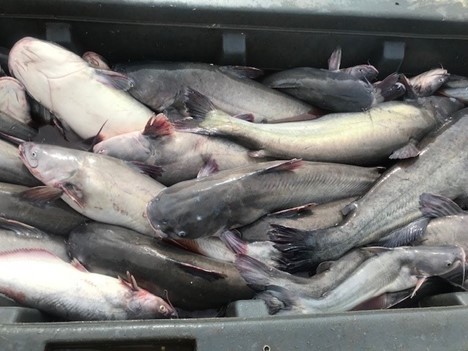
Photo Credit: Rocky Rice
Unforeseen Consequences
In the mid-1970s, the Chesapeake Bay and its tributaries were overfished and highly polluted. In response, fisheries managers in Virginia decided they needed to stock a different type of fish – a hearty specimen that could handle the poor conditions, offer anglers a good fight, and provide nice table fare. They settled on blue catfish. An added benefit they saw to this freshwater species was that it wouldn’t be able to spread beyond the targeted rivers.
“They thought because they are river fish they wouldn’t tolerate the saltwater conditions in the Bay,” said Dr. Noah Bressman, assistant professor in the Department of Biology at Salisbury University. “But they were wrong.”
Managers initially released blue catfish into the James and Rappahannock rivers, but they have since spread widely throughout most of the upper Bay. Today, blue catfish can be found in every major tidal river in Maryland, and in some locations make up as much as 70 percent of the total biomass.
“As an apex predator, invasive blue catfish continue to impact the ecological balance of the Chesapeake Bay by competing with native species for important forage species like menhaden and herring,” said Dave Sikorski, executive director of Coastal Conservation Association Maryland.
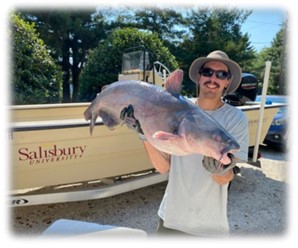
Photo Credit: Noah Bressman
Not a Picky Eater
Dr. Bressman is a top expert on invasive blue catfish, researching such areas as their primary diet, feeding behavior, and ecology in the Bay. His lab uses boat-based electrofishing with the Maryland Department of Natural Resources to catch hundreds of thousands of blue catfish for research. What they’ve learned is that these generalistic, opportunistic omnivores—much like coyotes or cockroaches—will eat anything.
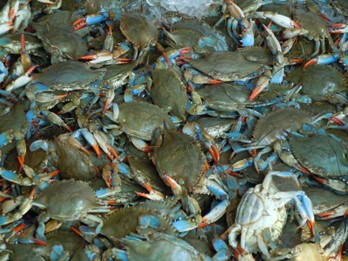
Photo Credit: AKZOphoto
Bressman’s research has turned up a 47-pound catfish with a whole adult wood duck in its stomach, and a 30-inch catfish with a 19-inch striped bass inside. Blue catfish eat many millions of blue crabs per year, and readily gorge on white perch, menhaden, striped bass (also known in Maryland as rockfish), even turtles and muskrats and their own young. On the Eastern Shore, they also target other important forage fish species – alewives and blueback herring. Tissue sampling evidence even suggests they are eating the eggs of striped bass, herring, and other fish, and as top predators they also compete with sportfish for the same prey.
“People think of catfish as slow-moving bottom feeders,” Bressman said. “But these are active predators. They eat anything and everything they can get their mouth around.”
If You Can’t Beat ‘Em, Eat ‘Em
Ask anyone, and they will tell you this problem is not going to go away. Bressman said that blue catfish are the most abundant fish, by biomass, in the rivers around the Bay. The problem has gotten so bad in the last couple decades that it’s actually generated a growing commercial fishery.
“What started as me targeting striped bass and hard crabs, and only fishing for blue catfish in between, has now gotten reversed,” said Rocky Rice, owner and operator of Piccowaxen Creek Seafood.
Rice has been commercially targeting blue catfish in the Potomac River for the last 12 years. He started fishing for these invasives merely to generate income in slow seasons, but now blue catfish are the main focus of his operation. Using primarily longlines and hoop pots, he targets fish in the best eating range of about 3 to 10 pounds.
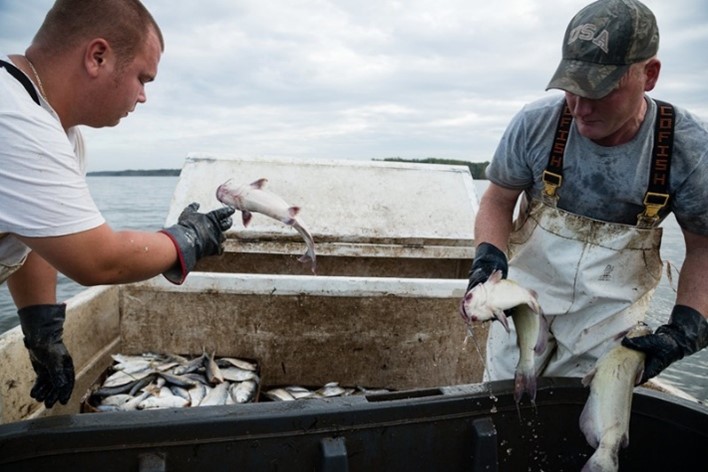
Photo Credit: Chesapeake Bay Program
And Rice is not alone. In 2022, commercial harvesters on the Potomac reported more than 3.1 million pounds of blue catfish landed, according to the Potomac River Fisheries Commission. This number far exceeds those for all other finfish species, except menhaden, harvested in the brackish river. By comparison, striped bass was the next highest fish species commercially landed at 428,000 pounds. And that’s just in the Potomac.
Unlike striped bass, whose numbers have been trending lower for years, blue catfish populations are practically impossible to eradicate, or even stunt. Rice says it’s one reason he targets this invasive.
“Granted I’m a fisherman and I need to make money,” Rice said. “But if I can minimize negative impacts on our native species also it’s a win-win.”
Dr. Bressman says just to keep the blue catfish population stable, fishermen must remove 15- to 30-million pounds of catfish from the Chesapeake Bay each year, and much more to reduce it. He asserts that without active human intervention, catfish could likely become the dominant predator in brackish portions of the Bay.
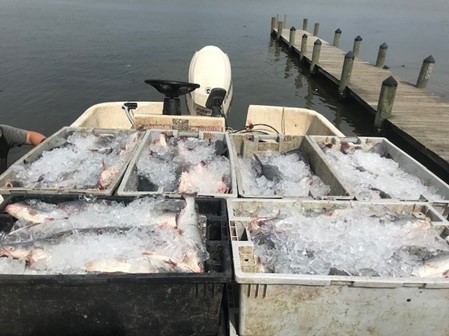
Photo Credit: Rocky Rice
Fun to Catch
So the best solution to keeping blue catfish populations in check, and to help protect native species, is one that offers real rewards: Go fishing. Blue cats are known for growing big, fighting hard, and tasting far better than most people expect. They’re also fairly simple to coax a bite from, and in Maryland there’s no catch limit.
If you’ve got a rod and reel, and willingness to target a different sort of fish, Rice says you can fish virtually anywhere in the brackish and fresh portions of the upper Bay. Dr. Bressman can back this up. In a previous tournament targeting blue cats, he fished from shore to pass the time while he waited for boats to come back in for weigh-ins. He had to stop one hour into the eight-hour tournament, and still almost won the shore fishing category with a half-dozen fish.
CCA Maryland, along with partners like Yamaha Rightwaters, is working to raise awareness with recreational anglers to help get them into the game. To target the threat of aquatic invasive fish species in the state, they offer fishing tournaments and other events to help engage anglers. A good example is the Great Chesapeake Invasives Count, which launched April 1 and runs through March 31, 2025.
Photo Credit: Noah Bressman
“To combat this looming issue, and empower anglers to do their part, CCA Maryland is proud to partner with Fish & Hunt Maryland, Maryland DNR, Maryland’s Best Seafood, and others to promote the opportunities for fishing that invasive catfish present, and support data collection efforts to help guide future management actions,” said Sikorski.
Even Better to Eat
“These aren’t your muddy-bottom catfish,” Bressman said. “They eat things we like to eat and that makes them taste better than other catfish.”
Bressman, Sikorski, and Rice all say they love dining on firm, flaky blue catfish filets, which taste quite similar to those of striped bass – largely because both species are active predators that compete for the same prey. The culinary value of this fish is catching on. Maryland’s Best, a state-run program that connects consumers with locally sourced agricultural products, offers a listing of 16 grocery stores and 24 restaurants that sell wild-caught Chesapeake blue catfish, to help support the state’s watermen and fight this invasive.
“It makes no sense for someone to buy a catfish that comes from overseas, because we have a better quality product right here,” Rice said. “We have to eat our way through this problem.”
Rice says he personally likes to deep fry the white, flaky filets, but has broiled and blackened them too. He’s even had blue catfish pot pie. He said their versatility and palatability is probably why chefs like these fish so much.
Photo Credit: Stephen McFadden
“I’ve fed it to a lot of my friends who’d said they didn’t like catfish,” he said, “and now that they’ve had it it’s one of their favorite foods.”
Do Your Part
If you do head out looking for blue catfish in the Bay area, be sure to share the photos and filets with family and friends – especially via online imagery – to help drum up interest. And whether or not you target these fish, if you ever catch one, be sure to not throw it back into the water alive (an exception being some parts of Virginia, where you need to be aware of a daily 20-fish creel limit and allowance for only one catfish over 32 inches).
Also important to note is that in some areas around the Chesapeake Bay, catfish – especially larger ones – along with other fish species like striped bass may have unsafe contaminant levels due to poor water quality. Avoid eating catfish over 30 inches long, remove the skin and fat when preparing, and and keep up with each state’s fish consumption advisories like those for Maryland, Virginia, Washington, D.C., and Delaware.
If you don’t want to catch or cook blue catfish, you can always support Bay-area businesses that offer locally sourced blue catfish filets. The bottom line is that dealing with blue catfish is an all-hands-on-deck situation, so the conservation community needs a lot of people working to tackle it in different ways.
“We need a cultural shift,” Bressman says. “The more catfish you eat, the more striped bass and blue crabs will be in the Bay.”
Learn about TRCP’s Aquatic Invasive Species Report here.
Link to original article.
Blue catfish vacuum up native species and are equally voracious when it comes to reproduction
“This is ground zero,” Mike Steiger, a fisheries biologist with Delaware’s Department of Natural Resources and Environmental Control, said one morning last month. Steiger was standing on a wooden walkway in the Russell Peterson Wildlife Refuge, looking over the steel-gray Christina River, a narrow tributary that twists through Wilmington, Del., and along I-95, eventually spilling into the Delaware River. “This is the first place we found them.”
That first find was a decade ago. In 2013, a recreational fisherman hooked an unfamiliar, 25-inch brute of a fish while casting into the Christina from a boat ramp in the town of Newport, about two miles from where Steiger now stood. The fisherman knew he had a catfish, but it didn’t look like a channel catfish, a common species in the Delaware River watershed. He snapped a photo and sent it off to the natural resources department.
The department forwarded the image to fishery biologists at the Virginia Institute of Marine Science who were quickly able to confirm that the fish in question was a blue catfish. The Christina “blue cat” was the first of its kind recorded in the watershed but it would not be the last. These days, Steiger and his counterparts in Pennsylvania and New Jersey are bracing for an invasion that has already upended marine ecosystems in Virginia and Maryland.
At first, the Christina blue catfish appeared to be an anomaly. The Delaware natural resources staff had put out an alert to Delaware anglers, asking them to notify the department of any other blue catfish encounters, but no additional reports surfaced for another five years. “For a long time, we wondered if someone had stocked this one fish here and that the fisherman just happened to catch it,” Steiger said.
How the blue catfish got in
But then, in 2018, during their annual gill-net surveys in the Delaware River, not far from the mouth of the Christina and adjacent to South Jersey’s Pennsville Township, Steiger and his colleagues hauled up more blue catfish. The following year, Steiger finally got what he believes is the answer to the question of how the lone 2013 fish had made it into the Christina: That September, eight big blue catfish were caught in the C&D Canal, the manmade corridor connecting the Delaware Bay with the Chesapeake Bay.
The reports have poured in ever since. “I believe the northeast section of the Chesapeake Bay is feeding our infestation,” Steiger said.
Chris Smith, who oversees invasive aquatic species for the New Jersey Department of Environmental Protection, agrees. “We don’t know for sure if the C&D Canal is directly where they came from,” Smith said. “But we can speculate that it’s the most likely pathway the blue cat took.”
Effect on ecosystem
“Invasive” is a tricky label. The channel catfish, which most New Jersey anglers would consider native, was in fact introduced in the state’s waters about a century ago. The largemouth bass, a beloved game species among freshwater fishermen, comes from the Mississippi River basin and the Southeast. At this point in history, when humans have so thoroughly and haphazardly scattered plants and animals across the globe, it is less about a species’ origin than it is about the impact it may have on its new ecosystem.
And blue catfish, Steiger said, “are big, angry, slimy, eating machines.”
In the 1970s, blue catfish — named for their silvery-blue hue — were stocked in Virginia to boost recreational fishing in the Rappahannock, York and James Rivers, whose ecosystems had been decimated by decades of pollution. Unlike the rivers’ native species, especially the shad and Atlantic sturgeon, blue catfish and other nonnative species, like the northern snakehead, thrive in the kind of low-oxygen environments that result from poor water quality.
Feasting on native species
Though they are native to the Mississippi, Missouri, Ohio, and Rio Grande River basins, blue catfish have also proven to be tolerant of salty water. When they reached the mouths of the Rappahannock, York and James, they had the entire Chesapeake Bay before them. Year by year, they crept north, vacuuming up native species, like menhaden, shad, river herring and blue crab.
Steiger and Smith worry that mature blue catfish may also enjoy eating young Atlantic sturgeon, a particularly worrying preference in the Delaware River and Bay, where fewer than 250 spawning adults remain. Each fall, Steiger and his colleagues conduct net sampling of juvenile Atlantic sturgeon in the Delaware River, about three miles downriver of the Christina’s mouth, and in recent years they’ve found blue catfish in their nets. “We’re only catching little ones, but if a 100-pounder was there, it could definitely eat a juvenile Atlantic sturgeon,” Steiger said. “We haven’t seen it yet, but it absolutely could happen.”
Blue catfish are equally voracious when it comes to reproduction — an aquatic version of the rabbit. During the spawning season, which runs from late May to June, a female blue catfish will produce up to 8,000 eggs per kilogram (2.2 pounds) of her body weight. The species can grow up to five feet and weigh over 100 pounds — a size that could yield over 360,000 eggs. “Snakeheads actually eat each other, so their numbers are kept down that way,” Steiger said. “Blue cats protect their young, so their numbers tend to explode.”
In New Jersey, Smith said, word-of-mouth reports of anglers catching blue catfish have made their way to the DEP for the past decade. But it wasn’t until 2021 that the department received a photo of a blue catfish that was caught in Salem County’s Lower Alloways Creek, a Delaware River tributary that is south of the C&D Canal and close to where the river turns into the Delaware Bay.
That the species is heading toward saltier water is a concern for the DEP, Smith said. He used the northern snakehead as a cautionary example. “We’ve confirmed them as far south as the Cohansey River this year, and, most likely, they will continue to expand down to the Maurice River,” he said. Both the Cohansey and Maurice rivers are in Cumberland County.
Anglers not dependable source of data
As of now, though, Smith and his colleagues have not detected any blue catfish below Lower Alloways Creek. But relying on anglers to map the species’ movement through the watershed is problematic. Many don’t bother — or don’t know — to report their catch to the DEP.
To fill that gap, Smith is hoping that, in the coming years, the DEP will invest in eDNA sampling, which is the process of identifying plant and animal species by analyzing the DNA they leave behind in the water column. “It’s a great screening tool,” Smith said. “We won’t have to do electrofishing” — a tool that uses an electrical current to temporarily stun fish — “or put a net in the water. We can just take a water sample and get a better indication of the distribution of species.”
Both Smith and Steiger, along with their counterpart in Pennsylvania’s Department of Environmental Protection, Sean Hartzell, are part of the Mid-Atlantic Panel on Aquatic Invasive Species, which brings together state and federal agencies, academic institutions, environmental groups and other stakeholders to develop and coordinate strategies to manage an ever-growing list of destructive invasive species.
For now, though, the most effective way to stay ahead of the blue catfish’s spread throughout the Delaware River watershed is regular coordination among Smith, Steiger, and Hartzell. If an angler reports a blue catfish or a northern snakehead or a freshwater drum — another recent arrival to the watershed — the three biologists will add that information to their growing body of research. If one turns up in the Delaware team’s Atlantic sturgeon nets, Steiger will alert the others.
Most importantly, Smith and Steiger said, is that anglers know a blue catfish when they see one, so that they can report it back to their state environmental agency. And then, if they’d like, they can take their catch home for dinner.
Link to original article.
There will be public hearings on Addendum 3. As of the printing of this newspaper we don’t have the New Jersey dates. The meeting was close to 6 hours long. I was allowed 2 minutes in the beginning to make comments about the blue catfish. There were two other people who spoke less than a minute each during the public comment period about the disastrous pollution and health of the Chesapeake Bay. Luckily the public got to comment 6 minutes in the beginning because the remainder of the 6 hours, only 4 members of the public were allowed to speak, two minutes each. That is less than 20 minutes total of public comment in a 6-hour meeting. There was no further opportunity for public comment before the votes. Since there had been no public hearings before this meeting, there should have been more opportunities for the public to comment. The Board Chairperson did not go to the public to get their opinions. This should always happen when they are drafting an amendment to go to public hearing. You wonder why the public feels they are not included. This just offers more proof. It was only during the public comment periods that we discussed the real issues that are impacting the health of the stocks and recruitment. The next 6 hours were spent on how we reduce the recreational and commercial catch. We know that reducing the recreational and commercial catch will not solve the problem since we have been doing that for at least the last 10 years without an improvement in recruitment. What they should have done was spend 6 hours discussing how we correct the real problems (climate change, pollution, endocrine disruptors and blue catfish). In my two minutes I discussed the federal legislation to create a pilot program to deal with blue catfish. I was hoping I would have a chance to tell the commissioners to go back to their states with a mandate to support the federal legislation. I know the Commission feels helpless since these issues are beyond the scope of their authority. It doesn’t help that the federal government and NOAA, because of the direction of the President, has taken climate change out of every opportunity for discussion at any agency.
There was a meeting during the Joint Meeting to discuss working on the proposed plan for sector separation in the recreational community. When you do sector separation in the commercial community, you give quotas to the particular harvesters of that quota based on history or the best data available. As an example, that is what they did in the bait industry on menhaden. They established the history of the reduction boats in relation to the bait harvesters and used that information to split the quota. That was a disaster because they gave the quotas that belonged to many reduction boats in different states all to Virginia instead of retiring them. The bait industry got a small quota. What do they do in the recreational sector when they try to decide the difference between charter and party boats? When Maryland did that in state waters many years ago, they gave 15% to party and charter boats and split the rest between the commercial and private recreational community. Claiming that the recreational data is so flawed that they can’t do this for the recreational community, they decided to bypass the rules of sector separation. But this data seems to them to be good enough to cut the quotas. They decide they can ignore the data when it shows that we should be catching more black seabass and scup. It seems the common recreational fisherman is always getting the short end of the stick. A perfect example is what they did on blue fish at this meeting. I will explain that under blue fish. Rules are rules and they should not be ignored.
They didn’t want to give us the increase the data suggested we should have. In 2019, they never went to public hearings with the sector separation and didn’t produce any data to support their decision. It was an arbitrary decision again not based on any data. Now in 2025, they are going to increase out catch of bluefish. Instead of raising both sectors equally, which they could have done, they decided to go with a 5/7 split, 5 for private boats and private fishermen and 7 for party and charter boats. Again, not producing any science to support their numbers. That is why I can’t support sector separation because that will result in quotas and bag limits within the recreational community based on who has more members on the council and commission. This will only create a division in the recreational community and will lead to us fighting among ourselves instead of speaking with one voice. We should have all demanded 10 fish as the data would have supported that. Or at least there should have been public hearings or other opportunities for public input. I had my hand up, but I was ignored. Someone mentioned that at one meeting I had my hand up for 40 minutes and at another for an hour but only got to speak for 4 minutes.
There were Joint Meetings of the Summer Flounder, Scup and Black Sea Bass Boards. The public participation was again severely limited. It seems when it is a commercial issue to be decided there is much debate and more public input. But when it is recreational measures being discussed, they don’t want to hear from the public. When I was a commissioner, my anglers would complain that I didn’t want to listen to their comments before making a decision. As I pointed out, I always made sure comments were heard from both the commercial and recreational communities. You need to put pressure on your commissioners to do the same. As usual, on black seabass and scup, they admit we are 200% above the target but the increase was very small. Just a way for them to say they did something. This is what is putting the charter and party boats, tackle stores, marinas and recreational anglers in distress. We are losing recreational anglers, we are making less trips and there is nothing to fish for at certain times of year. They have not dealt with the economic impact. When they look at the commercial, they look at how much they are getting per pound, and how to adjust the quota to support maximum value. With the recreational sector, they have never considered the millions of dollars lost to the recreational industry based on their decisions. Considering economic impact is required but they always say they have the best available data that they can afford. Nothing has changed.
Draft Addendum Considers Further Fishery Reductions
Arlington, VA – The Commission’s Atlantic Striped Bass Management Board approved for public comment Draft Addendum III to Amendment 7 to the Interstate Fishery Management Plan (FMP) for Atlantic Striped Bass. The Draft Addendum considers management measures to support rebuilding the stock by 2029. The Draft Addendum will also address requirements for commercial tagging programs, a coastwide definition of total length for size limit regulations, and changes to the Maryland recreational season baseline.
The Board initiated the Draft Addendum in response to stock projections indicating a low probability of meeting the 2029 stock rebuilding deadline. The most recent stock projections estimate an increase in fishing mortality in 2025 due to the above average 2018 year-class entering the current recreational ocean slot limit. There is also concern about the lack of strong year-classes behind the 2018 year-class.
This proposed action is intended to increase the probability of rebuilding the stock by reducing fishery removals by 12% with management measures implemented in 2026. For the commercial fishery, the Draft Addendum proposes a commercial quota reduction. For the recreational fishery, the Draft Addendum considers season closures and/or size limit changes. For Maryland’s Chesapeake Bay recreational fishery, the Draft Addendum also proposes changing the recreational baseline season to simplify Maryland’s Chesapeake Bay regulations, which could improve compliance and enforcement, and to re-align fishing access based on stakeholder input and release mortality rates.
For commercial tagging, the FMP currently allows states to choose whether to tag commercially harvested fish at the point of harvest or point of sale. To address concerns that waiting to tag harvested fish until the point of sale could increase the risk of illegal harvest, the Draft Addendum considers requiring commercial tagging at the point of harvest or first point of landing intended to improve enforcement and compliance.
There is also concern that inconsistent methods of measuring the total length of striped bass for compliance with size limits undermines the intended conservation, consistency, and enforceability of the coastwide size limits. To address this, the Draft Addendum considers coastwide requirements for defining total length for both sectors.
The Draft Addendum will be posted to the website in late August at this link. A subsequent press release will provide the details on the public hearing schedule and how to submit written comments. The Board will meet to review submitted comments and consider final action on the addendum in October 2025 at the Commission’s Annual Meeting in Dewey Beach, DE.
For more information, please contact Emilie Franke, Fishery Management Plan Coordinator, at efranke@asmfc.org or 703.842.0740.
Meeting Summary
In addition to approving Draft Addendum III for public comment, the Atlantic Striped Bass Management Board met to receive a report on the ten-year review of commercial tagging programs and consider the draft Fishery Management Plan (FMP) Review and state compliance for fishing year 2024.
The Board received a report on the ten-year review of the commercial tagging program. In August 2024, the Board tasked the Plan Review Team (PRT) with reviewing the striped bass commercial tagging program since it has been over a decade since program implementation through the FMP. The PRT and state commercial tagging contacts met in July 2025 to provide overviews of each state’s tagging program, share information and best practices among states, discuss key observations across programs, and streamline reporting. A written report of those discussions is being developed in August 2025. The Board requested that the Law Enforcement Committee (LEC) meet prior to the 2025 Annual Meeting, if possible, to review the report and discuss any further LEC recommendations on point of tagging and potential improvements to state tagging programs.
Finally, the Board approved the Atlantic Striped Bass FMP Review for the 2024 fishing year and state compliance reports. For more information, please contact Emilie Franke, Fishery Management Plan Coordinator, at efranke@asmfc.org or 703.842.0740.
Motions
Move to approve the Atlantic Striped Bass FMP Review for the 2024 fishing year and state compliance reports. Motion made by Mr. Hasbrouck and seconded by Mr. Sikorski. Motion approved by unanimous consent Move to remove the 18% reduction option in Section 3.4 (Option D & E) Motion made by Mr. Clark and seconded by Ms. Meserve. Motion passes (13 in favor, 1 opposed, 2 abstentions). Move to remove in Section 3.4 Option C (0% commercial reduction and -14% recreational reduction). Motion made by Ms. Meserve and seconded by Mr. Sikorski. Motion pass (8 in favor, 6 opposed, 2 abstentions). Main Motion Move to remove no-targeting closure options for the ocean. Motion made by Mr. Gary and seconded by Mr. Gates. Motion amended. Motion to Amend Motion to amend to include “with the assumption that striped bass only trips are eliminated” at the end of the sentence Motion made by Mr. Nowalsky and seconded by Mr. Hasbrouck. Motion passes (9 in favor, 6 opposed, 1 null). Main Motion as Amended Move to remove no-targeting closure options for the Ocean with the assumption that striped bass only trips are eliminated Motion passes (12 in favor, 3 opposed, 1 null). Main Motion Move to remove in Section 3.4 option B: options CB2, CB3, CB5. Motion made by Mr. Sikorski and seconded by Mr. Clark. Motion to Amend Move to amend to remove “CB3” Motion made by Ms. Meserve and seconded by Mr. Luisi. Motion passes (14 in favor, 2 abstentions). Move to remove in Section 3.4 option B: options CB2 and CB5. Motion passes by unanimous consent. Move to remove no-targeting closure options for the Chesapeake Bay with the assumption that striped bass only trips are eliminated Motion made by Ms. Meserve and seconded by Mr. Grout. Motion passes (12 in favor, 4 opposed). Move to add an option for tagging at first point of landing in Section 3.2 Motion made by Mr. Clark and seconded by Mr. Borden. Motion passes by unanimous consent. Main Motion Move to remove in Section 3.3 Option D (25% uncertainty buffer for the Maryland season baseline). Motion made by Mr. Sikorski and seconded by Mr. Clark. Motion to Amend Move to amend to add “and Option B (MD baseline with no buffer)” to the end of the sentence. Motion made by Ms. Meserve and seconded by Mr. Grout. Motion fails (4 in favor, 8 opposed, 4 abstentions). Move to remove in Section 3.3 Option D (25% uncertainty buffer for the Maryland season baseline). Motion made by Mr. Sikorski and seconded by Mr. Clark. Motion passes (10 in favor, 3 opposed, 3 abstentions). Move to approve Draft Addendum III for public comment as modified today. Motion made by Mr. Clark and seconded by Mr. Luisi. Motion passes by unanimous consent.