Contents:
In its inception, the Magnusson/Stevens Act promised that fisheries would be rebuilt and the recreational and commercial communities would eventually reap the benefit of agreement with stricter management in the short term. The recreational and commercial communities did their part. We agreed to and implemented smaller quotas and took drastic cuts in our fisheries. We were told all of these decisions would be based on good science. After 24 years, we are still waiting for the pay-off and better science. But it just seems that things keep getting worse. More promises were made in the 2006 reauthorization and those promises were not kept. JCAA did not support the reauthorization the way it was presented because we felt there were significant flaws. What Congress eventually passed was never implemented because the funding necessary to do the job effectively was never authorized. If you have read my columns in the past, you are probably having a “broken record” moment. But after the last few meetings, I just have to revisit this issue.
There are two areas that are of greatest concern right now.
First, recreational data collection has not improved. In fact, it has gotten worse. In the 2006 reauthorization, Congress directed NMFS to correct the flaws in data collection by 2009. It is now 2016 and many of us feel the data is more useless than ever. Instead of totally designing a new system, they insisted on working with an old system that was never designed to capture the recreational landings that would be useful for fisheries management. They continued to tweak the faulty system without ever getting to the actual problem. They use contractors who have no understanding of a completely random sample. There are many examples we could discuss but the one that makes the point most clearly comes from 2013. Sandy created a huge issue in the recreational fishing industry. Many marinas were not in operation for most of the year. And even in the open marinas, there were few boats in the water. Particularly in May and June, when the summer flounder season opened in New Jersey and New York, few anglers were found on the water. Yet, the data says New Jersey anglers caught more fish in May and June of 2013 than we did in 2012. It doesn’t take a high IQ to know those numbers are wrong. But when I questioned the people collecting the data, they joked in reply. Their off-the-cuff answer made no sense. The data was never corrected. I had clearly stated there was no way we would go over our summer flounder quota in 2013 but the flawed data proved me wrong! I should have known better. NMFS data collection is seriously flawed and this will never improve until Congress authorizes the money and NMFS makes a real effort to correct the problem. Charter and party boat captains have also lost faith in the system that they are not cooperating with the collection system. This creates a vicious cycle and no one wins.
Second, the stock assessments are still created using the same bad data that we were using 25 years ago. We have not spent the money necessary to get more biological data for the stock assessments. Instead, we try to do quick fixes by using more sophisticated models to handle more bad data. Congress and NMFS keep promising more money into stock assessment data collection but it hasn’t happened yet. Congress tells us that they are ordering NMFS to fix the problem. And NMFS tells us that there is no money to fix the problem. The bottom line is the recreational and commercial communities are catching fewer fish than they were 25 years ago when we all agreed that the stocks were in serious trouble. Even though the health of many stocks have improved dramatically and increased their range, neither community is allowed to benefit from the earlier sacrifices. This has put many commercial fishermen out of business. In the recreational community, party boats, charter boats, tackle stores and boat builders are all in decline. The number of recreational fishing trips has dropped by 6,000,000 in the mid-Atlantic region from 2007 to 2014. The number of boats registered in New Jersey has dropped by 50,000 since from 2007 – 2014. If we could hold Congress and NMFS accountable for doing such a miserable job, they would all be fired! Instead they make more promises.
Virginia Beach, VA – The Mid-Atlantic Fishery Management Council (Council) and the Atlantic States Marine Fisheries Commission (Commission) reviewed previously implemented specifications for scup, black sea bass and bluefish fisheries and modified specifications for summer flounder. The Commission’s actions are final and apply to state waters. The Council will forward its federal waters recommendations regarding summer flounder specifications to NOAA Fisheries Greater Atlantic Regional Fisheries Administrator for final approval.
The table below summarizes commercial quotas and recreational harvest limits for summer flounder, scup, black sea bass, and bluefish (2016 values are provided for comparison purposes). Please note specifications for years 2017 and beyond may be adjusted based on changes in the fishery or new scientific information.
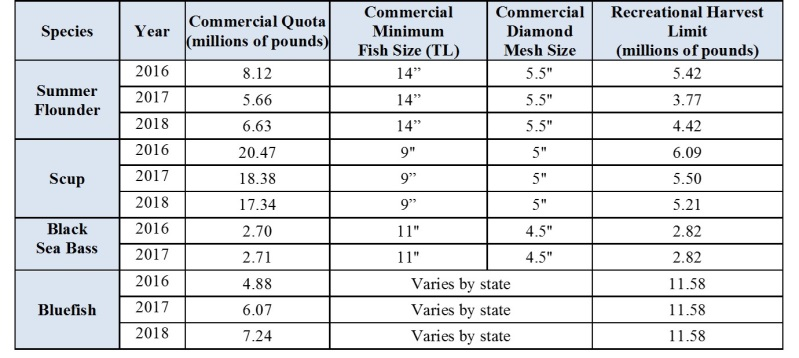 Table 1: Commercial quotas and recreational harvest limits for summer flounder
Summer Flounder
For summer flounder, both groups approved a commercial quota of 5.66 million pounds and a recreational harvest limit of 3.77 million pounds for 2017, an approximate 30% decrease from 2016. This decrease in catch and landings limits responds to the findings of the 2016 stock assessment update, which indicates summer flounder has been experiencing overfishing since 2008. In 2015, fishing mortality exceeded its threshold by 26% (i.e., the level beyond which overfishing is occurring). The 2015 estimate of spawning stock biomass (SSB) is at 58% of the biomass target, and only 16% above the threshold. If the stock were to fall below the Species Year Commercial Quota (millions of pounds) Commercial Minimum Fish Size (TL) Commercial Diamond Mesh Size Recreational Harvest Limit (millions of pounds) Summer Flounder 2016 threshold, it would be considered overfished, requiring the development of a rebuilding plan to reduce fishing mortality and rebuild stock biomass. These results appear to be driven largely by below-average recruitment, an underestimation of the fishing mortality level in the last years of the assessment, and declining biomass indices. The assessment update indicates the stock experienced six below-average year classes from 2010 to 2015. Additionally, indices of abundance from state and federal surveys have indicated declines in abundance ranging from 9 to 97% from their most recent peaks (generally 2009 to 2012). The 2016 assessment update estimated biomass has been trending down since 2010. Summer flounder harvest limits for 2018 may be adjusted in the future based on changes in the fishery or new scientific Information.
Scup and Black Sea Bass
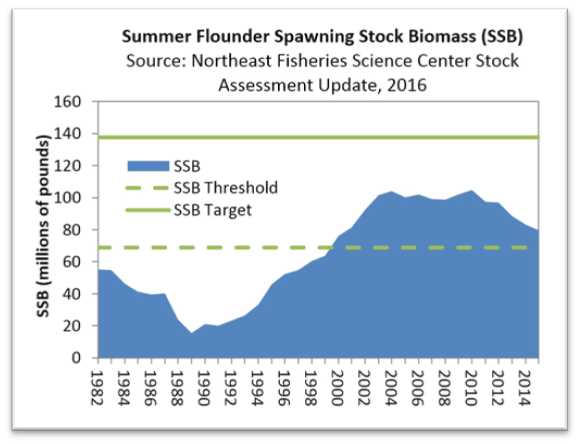 Summer Flounder Spawning Stock Biomass (SSB)
For scup and black sea bass, the Commission and Council maintained the previously implemented multi-year specifications set in August and October 2015, respectively. The decline in harvest limits for scup since 2016 is due to a decrease in SSB as projected by the 2015 benchmark stock assessment.
For black sea bass, 2017 harvest limits remain unchanged relative to 2016 levels (in 2016, there was a reduction in the commercial quota due to overages in the previous year). Both the commercial quota and recreational harvest limit may be changed pending the results of next benchmark stock assessment, scheduled for peer review through the Northeast Regional Stock Assessment Workshop/Stock Assessment Review Committee in late 2016. The Commission and Council will consider the results of the benchmark stock assessment in early 2017.
Bluefish
For the bluefish fishery, the final 2016 commercial quota is 4.88 million pounds and the recreational harvest limit is 11.58 million pounds. The final 2016 harvest limits include a 1.58 million pound transfer from the recreational sector to the commercial sector. The Commission and Council did not make any changes to the 2017 and 2018 specifications. The 2017 and 2018 commercial quotas and recreational harvest limits are preliminary and will likely change following release of 2016 and 2017 final Marine Recreational Information Program harvest estimates. These estimates can impact how much is transferred from the recreational sector to the commercial sector.
For all four species, the Commission and Council actions are consistent with the recommendations of the Council’s Scientific and Statistical Committee based on the best available scientific information. For more information about these fisheries, please contact one of the following staff members:
After a half-dozen tries at setting a new harvest quota for what’s widely regarded as the most important fish in the ocean, a regulatory agency gave up on Wednesday. It’ll tackle the issue again in October.
A board of the Atlantic States Marine Fisheries Commission, which regulates fishing in coastal waters from Maine to Florida, spent 3½ hours trying to reach a consensus on what to do about harvests of menhaden in 2017.
The small, oily fish aren’t good eating for humans. But swimming in huge schools, they’re staples in the diets of whales, rockfish and many other marine creatures. They’re also widely used as bait by fishermen and crabbers, and hauled by the tens of millions each month to a plant on Virginia’s Northern Neck where they’re processed into everything from fish oil pills to cattle-feed supplements.
That has made for a long history of controversy over menhaden regulation, but few gatherings have exposed the divides more clearly than Wednesday’s. At their meeting in Alexandria, members of the commission’s menhaden board voted on proposals ranging from no change in next year’s coastwide catch to a 19 percent increase. Some of them failed on 9-9 votes, and none won enough support to pass.
“Difficult issues, complex questions, competing interests and a lot of passion,” was how commission member Robert Boyles, South Carolina’s deputy director for marine resources, summed up the debate.
“This was a remarkable day. I’ve never seen anything like it,” said Joseph Gordon, who oversees Northeast fisheries issues for The Pew Charitable Trusts.
Board members heard public comments that were no less divided.
Representatives of Omega Protein Corp., the Houston-based company whose plant in Reedville processes the lion’s share of the menhaden caught along the coast, argued for an increase in the quota of 20 to 30 percent. This year’s coastwide cap, which includes the Chesapeake Bay, is 187,880 metric tons – the same as in 2015. It was 10 percent lower in 2014.
“There’s very little risk now” in increasing the limit further, argued Ben Landry, Omega’s director of public affairs.
A commission technical committee comprising 21 fisheries scientists concluded that a hike of as much as 40 percent in 2017 would pose zero risk of overfishing menhaden. Just as the commission has previously cut the quota out of concern for overfishing, “fundamental fairness” demands that it increase it now, Landry said.
Monty Deihl, Omega’s vice president of operations, pleaded that a higher cap would allow his company to rehire laid-off workers: “There’s really no reason why we can’t put all these people back to work.”
But Patrick Paquette, a recreational fisherman from Cape Cod., Mass., decried any quota increase as premature. He said that, in the past few years, a “wall of menhaden” returned to the waters off Cape Cod, and sport fishing has surged as a result: “It’s like our ecosystem is rejuvenated.”
A similar rebound has occurred off New York in Long Island Sound.
Paquette, other recreational anglers and conservationists argued the commission should hold off on raising the limit to give menhaden more time to get re-established on the edges of their Atlantic range. They said there’s still not enough evidence of an overall increase in the fish population, and noted that the recent analysis Omega says justifies a larger quota is based on 2013 data.
Opponents of a quota increase also said the analysis didn’t consider the effect on species that prey on menhaden. The commission’s staff has begun work on an “ecological-based” management system that would take into account predator needs. But the earliest that initiative, known as Amendment 3, would go into effect is 2018.
Gordon said he was heartened that most board members continued to voice support for the new management approach, even amid their divisions over next year’s quota.
Robert Ballou, a Rhode Island fish and wildlife department official who chaired the meeting, tried many ways to move the body toward consensus. He first oversaw votes on substitutes offered to the original motion for a 20 percent quota increase. Besides a proposal for no change in the quota, hikes of 1 percent, 5 percent, 10 percent and 19 percent were considered, and a second vote was taken on a 10 percent increase. After all motions failed, Ballou argued against voting on the 20 percent hike, saying he’d been advised by legal counsel that if that motion was defeated, there would be no limit on menhaden catches in 2017.
In the end, the board voted 10-7, with the Virginia and North Carolina delegations among the yeas, to try again for a quota at the annual meeting of the Atlantic states commission. It’s scheduled for Oct. 24-27 in Bar Harbor, Maine.
“We have actually made a decision. How about that?” Ballou exclaimed. “That was a pretty interesting ride.”
Alexandria, VA – The Atlantic States Marine Fisheries Commission’s Atlantic Menhaden Management Board approved Addendum I to Amendment 2 to the Interstate Fishery Management Plan for Atlantic Menhaden. The Addendum modifies the bycatch provision of Amendment 2 by allowing two permitted commercial fishermen working together from the same vessel using stationary multi-species gear to land up to 12,000 pounds of menhaden per trip per day. In this case, stationary multi-species gears are defined as pound nets, anchored/staked gillnets, and fyke nets. Interested states may implement the new bycatch provision as their regulatory processes allow, but no earlier than August 15.
The practice of two permitted fishermen working together from the same vessel to harvest Atlantic menhaden primarily occurs in the Chesapeake Bay pound net fishery. This practice enables the fishermen to pool resources for fuel and crew. However, the practice was constrained under Amendment 2’s bycatch allowance provision, which stipulated a 6,000 pound/vessel/day limit.
Board members also discussed 2017 specifications but postponed final action on these measures until the Commission’s Annual Meeting in late October. Addendum I will be available of the Commission website, www.asmfc.org, on the Atlantic Menhaden page by mid-August. For more information, please contact Megan Ware, Fishery Management Plan Coordinator, at mware@asmfc.org or 703.842.0740.
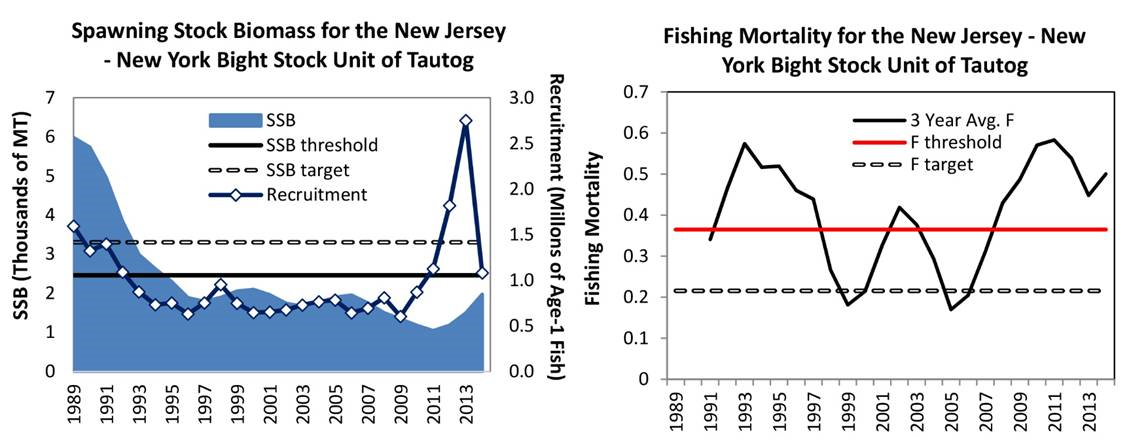
Alexandria, VA – The Commission’s Tautog Management Board approved regional stock assessments for Long Island Sound (LIS) and New Jersey-New York Bight (NJ-NYB) for management use. Stock status for both regions was found to be overfished and experiencing overfishing. The assessments were initiated in response to the findings of the 2015 benchmark stock assessment which explored a number of regional breakdowns for management purposes, including the option of: (1) Massachusetts and Rhode Island; (2) Connecticut, New York and New Jersey; and (3) Delaware, Maryland and Virginia. The Board had concerns about the biological implications of grouping LIS with New Jersey ocean waters. The Board requested a new assessment that would explore the population dynamics of the Connecticut, New York and New Jersey region in more detail. The regional assessments propose two additional stock unit boundaries for consideration at a finer regional scale: LIS, which consists of Connecticut and New York waters north of Long Island, and NJ-NYB, which consists of New Jersey and New York waters south of Long Island.
Given approval of the regional assessments by the peer review panel and Management Board, the Tautog Technical Committee will move forward with updating the benchmark stock assessment, including data through 2015 for all four regions for Board review and approval in October. Upon its completion, work on developing a new amendment to the Tautog Fishery Management Plan can begin. The draft amendment will propose a four region management approach: Massachusetts and Rhode Island; Long Island Sound; New Jersey/New York Bight; and Delaware, Maryland and Virginia. It is anticipated a draft for public comment will be presented to the Board for its review and approval in February 2017, with final amendment approval later in the year.
The stock assessments and peer review report, which are combined into one document, will be available on the Commission website, www.asmfc.org, on the Tautog page by the end of August. For more information on the stock assessments, please contact Katie Drew, Senior Stock Assessment Scientist, at kdrew@asmfc.org; and for more information on tautog management, please contact Ashton Harp, FMP Coordinator, at aharp@asmfc.org.
Fishermen have fished the Manasquan Ridge for generations but now they fear it could be vacuumed up to build dunes on the beach.
The appearance of the 123-foot offshore supply vessel Scarlett Isabella on the Manasquan Ridge is a bad omen to Capt. Jim Lovgren, a Point Pleasant Beach commercial fisherman.
The Scarlett was in the hire of the Bureau of Ocean Energy Management, which is looking for potential sand on the outer continental shelf that could be pumped up onto the Jersey beach. Tampering with these sand beds, which are long-established fishing areas, could reshape the fishing communities at the Shore, fishermen say.
The ridge, which starts to rise off the ocean floor 5 ½ miles southeast of Manasquan Inlet, is one of those potential resources of sand.
"Last year word was that Manasquan Ridge was a last resort for beach replenishment use. The fact that they are paying a survey vessel to crisscross it clearly says something different," said Lovgren, who sits on the Executive Board of the Garden State Seafood Association.
Fishermen have been weary of a conflict with the Army Corps of Engineers over the ridge, and others nearby, which they depend on to hold fish.
They are still bitter about Army Corps' use of nearly half of the 683-acre Harvey Cedars Lump for the Long Beach Island to Little Egg Inlet beach replenishment project.
"It's always a bad idea to destroy a ridge. You know, the government is worried about overfishing but they have no problem destroying a fishing habitat," said Capt. Dale Steinart, a long-time party boat captain.
The Manasquan Ridge is 1,700 acres - about 1,500 football fields - of underwater sand hills that rise about 20 feet off the bottom. There are a few scattered shipwrecks and rock ledges on it.
Baitfish called sand eels survive in its eelgrass, which in turn attract the state's most commercially valuable finfish: summer flounder. Commercial fishermen like Lovgren tow their nets east to west, north to south to gather up the fish.
In 2014 commercial landings of summer flounder statewide netted fishermen $4.8 million on the wholesale market, according to the latest figures from the National Oceanic and Atmospheric Administration.
Flotillas of party boats have historically drifted the ridge for bluefish and mackerel.
The Army Corps has it in its sights now for sand to maintain a $5.1 million coastal dune project from Manasquan Inlet to Island Beach State Park. It said the ridge has 38.6 million cubic yards of suitable beach fill material.
"We're not going to use it at the project start. But we are looking at it for the long term. It's a 50-year planning project," said Ed Voigt, a spokesman for the U.S. Army Corps of Engineers Philadelphia District.
The Army Corps identifies the Manasquan Ridge as "Borrow Area F2." After initial construction of the on-shore berms, it wants to replenish the beach every four years with 961,000 cubic yards of sand. That would total about 12 million cubic yards, or a third of the ridge, over the 50-year span of work. Giant Stadium, for example, can hold 64 million cubic yards from top to bottom.
It said there are no economically viable land sources of sand for the large quantities needed for these projects. The ridge's sand is also the right grain texture, the corps said.
The Army Corps would need the Bureau of Ocean Energy's permission to vacuum it up because that agency has jurisdiction over sand in federal waters, typically 3 to 200 nautical miles from the shoreline.
To this point they haven't asked for permission, said Marjorie Weisskohl, BOEM spokesperson.
The project — long bogged down on land as the state Department of Environmental Protection collected easements from seaside property owners — could go out to bid in September and begin as early as next spring season, Voigt said.
It still faces holdouts in the towns of Point Pleasant Beach, Bay Head, part of Mantoloking and Berkeley. Those areas will not get fill at the start of the project, said Voigt.
The DEP remains adamant about getting this coastal project completed after the devastation caused by Sandy almost four years ago.
"What’s at stake is protection of lives, homes, businesses and infrastructure, as well as many thousands of jobs and billions of dollars in tourism revenues," said Larry Hajna, a DEP spokesperson.
Fishermen, however, say that removing the sand could have unintended consequences.
"To take away some of this is going to change the ecosystem of the area that's there," said Capt. William Egerter Jr. skipper of the party boat Dauntless.
MOST Westerners facing criminal charges in Cambodia would be thanking their lucky stars at finding themselves safe in another country. But Alejandro Gonzalez-Davidson, who is half British and half Spanish, is pleading with the Phnom Penh government to allow him back to stand trial along with three Cambodian colleagues. They’ve been charged, essentially, with interfering with the harvesting of one of the 21st century’s most valuable resources: sand.
Believe it or not, we use more of this natural resource than any other except water and air. Sand is the thing modern cities are made of. Pretty much every apartment block, office tower and shopping mall from Beijing to Lagos, Nigeria, is made at least partly with concrete, which is basically just sand and gravel stuck together with cement. Every yard of asphalt road that connects all those buildings is also made with sand. So is every window in every one of those buildings.
Sand is the essential ingredient that makes modern life possible. And we are starting to run out.
That’s mainly because the number and size of cities is exploding, especially in the developing world. Every year there are more people on the planet, and every year more of them move to cities. Since 1950, the world’s urban population has ballooned to over 3.9 billion from 746 million.
According to the United Nations Environment Program, in 2012 alone the world used enough concrete to build a wall 89 feet high and 89 feet wide around the Equator. From 2011 to 2013, China used more cement than the United States used in the entire 20th century. To build those cities, people are pulling untold amounts of sand out of the ground. Usable sand is a finite resource. Desert sand, shaped more by wind than by water, generally doesn’t work for construction. To get the sand we need, we are stripping riverbeds, floodplains and beaches.
Extracting the stuff is an estimated $70 billion industry. It runs the gamut from multinational companies’ deploying enormous dredges to villagers toting shovels and buckets. In places where onshore sources have been exhausted, sand miners are turning to the seas.
This often inflicts terrible costs on the environment. In India, river sand mining is disrupting ecosystems, killing countless fish and birds. In Indonesia, some two dozen small islands are believed to have disappeared since 2005 because of sand mining. In Vietnam, miners have torn up hundreds of acres of forest to get at the sandy soil underneath.
Sand miners have damaged coral reefs in Kenya and undermined bridges in Liberia and Nigeria. Environmentalists tie sand dredging in San Francisco Bay to the erosion of nearby beaches.
People are getting hurt, too. Sand mining has been blamed for accidental deaths in Saudi Arabia, South Africa and Gambia. In India and Indonesia, activists and government officials confronting black-market sand mining gangs have been killed.
Stronger regulations can prevent a lot of this damage, and do in most developed countries. But there’s a downside. Sand is tremendously heavy, which makes it expensive to transport. If you forbid sand mining in your backyard — as many American communities are trying to do — then it has to be trucked in from somewhere else. That drives up the price. Concrete is relatively cheap; if the cost of making a new building or road were to double, it could hit the economy hard.
Not to mention the extra truck traffic and pollution. California state officials estimated that if the average hauling distance for sand and gravel increased to 50 miles from 25 miles, trucks would burn through nearly 50 million more gallons of diesel fuel every year.
We can make more sand, but crushing rock or pulverizing concrete is costly, and the resulting sand is ill suited for many applications. We can use alternative substances for some purposes, but what other substance can we possibly find 40 billion tons of, every year?
The fishing villages in the mangrove-rich estuaries of Cambodia’s Koh Kong province might be the canaries in the global sand mine. For years, villagers have complained that rampant sand mining is wiping out the crabs and fish that provide their living. Locals told me on a recent visit that families have had to send members to work in Phnom Penh garment factories, or have simply moved away. The dredging also threatens endangered native dolphins, turtles and otters.
Last year, members of Mother Nature, an environmental group led by Mr. Gonzalez-Davidson and others, began a campaign to rein in the mining, organizing villagers to blockade and board the dredging ships. The government, which had expelled Mr. Gonzalez-Davidson a few months earlier for blocking road access to government officials trying to reach a hydropower dam in the province, arrested three of the activists, charging them with threatening to damage dredging boats, an offense that could mean two years in prison (Mr. Gonzalez-Davidson was charged in absentia as their accomplice a few months later).
Mr. Gonzalez-Davidson, who lives in Barcelona, is petitioning to be allowed back to attend his own trial. Meanwhile, the three jailed Cambodians have been denied bail for the past 10 months. Their trial has finally been scheduled for the end of June. There’s an urgent question of justice for them. For the rest of us, there’s a profound lesson. Hardly anyone thinks about sand, where it comes from or what we do to get it. But a world of seven billion people, more and more of whom want apartments to live in and offices to work in and malls to shop in, can’t afford that luxury anymore.
It once seemed as if the planet had such boundless supplies of oil, water, trees and land that we didn’t need to worry about them. But of course, we’re learning the hard way that none of those things are infinite, and the price we’ve paid so far for using them is going up fast. We’re having to conserve, reuse, find alternatives for and generally get smarter about how we use those natural resources. That’s how we need to start thinking about sand.
Vince Beiser, a journalist, is working on a book about the global black market in sand. (Link to article)