Contents:
JCAA and all the citizens of New Jersey owe a huge debt of gratitude to Senators Menendez and Booker and Congressmen Pallone and LoBiondo for their work in persuading President Obama to withdraw the mid-Atlantic from consideration for offshore drilling for oil and gas. We also thank Cindy Zipf for her hard work organizing the rally and other events and everyone who attended, called, emailed or wrote to the President about this issue. This is a big win for the ocean. Read Articles below with more info.
It's a great day for the Atlantic Ocean and the thousands of citizens who fought to protect the coast! The sea is spared from oil drilling and the horrific consequences that Big Oil brings-pollution, spills and industrialization. This ends a 10-year battle and preserves the shore, which is the "goose that lays the golden eggs" by supporting billions of dollars and hundreds of thousands of jobs in tourism and fisheries.
It is a clear "David and Goliath" victory that proves the power of the people. Clean Ocean Action (COA) commends the coalition, businesses, citizens and national network of groups who never gave up, and fought hard to protect the ocean from drilling. While this is a great victory, there are still ocean realms threatened by drilling. Since there is truly only one ocean, drilling anywhere puts all regions at risk. COA also works to stop seismic testing which still looms.
Importantly, we thank New Jersey's bi-partisan congressional delegation that almost unanimously and consistently fought against drilling offshore, and for the leadership of the team: US Senators Menendez and Booker, US Representative Frank Pallone and US Representative Frank LoBiondo.
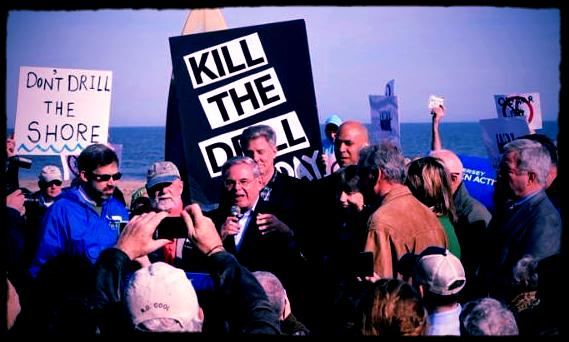
 Photos from the rally
Feds remove Atlantic Coast from Ocean-floor Oil Exploration Program
WASHINGTON - The Atlantic coast has been removed from a plan that would have opened the ocean floor to oil exploration and drilling, a move that environmental groups and New Jersey elected officials said would have imperiled the Shore economy.
U.S. Sens. Cory Booker and Robert Menendez, U.S. Rep. Frank Pallone and various New Jersey organizations announced Tuesday that federal officials heeded their protests and removed the Atlantic coast from the leasing program.
The federal Bureau of Ocean Energy Management was considering oil and gas exploration off the coasts of Virginia, South Carolina, Georgia and North Carolina. The Atlantic’s inclusion in the Outer Continental Shelf Oil and Gas Leasing Program worried groups throughout New Jersey.
If another disaster like the 2010 BP Deepwater Horizon explosion happened in the Atlantic, they said, New Jersey’s $40 billion-a-year tourism industry would be crippled by tarslicked beaches and oilcoated animals.
“I’m pleased the administration heard our voices and put the values of New Jerseyans ahead of the financial interests of the oil industry,” Menendez said in a news release. “Standing together, we proved we can beat Big Oil and protect our Jersey Shore for generations to come.”
Jeff Tittel, director of the New Jersey Sierra Club, said even a spill off the coast of Virginia would make its way north to the Jersey Shore.
“One quart of oil pollutes a million gallons of water,” he said in a news release. “Coastal states surrounding the Gulf of Mexico are still impacted by the 170 million gallon spill from BP’s Deepwater Horizon oil rig explosion in 2010. We don’t want the same thing to happen here on the East Coast.”
The mission of the leasing program, according to a draft, is to increase domestic oil and gas production, promote energy security and create jobs.
In an early draft of the proposed drilling plan, the Bureau of Ocean Energy Management stated: “Working with a host of stakeholders, USDOI (the U.S. Department of the Interior) has developed and implemented reforms and improvements designed to reduce the risk of another loss of well control in our oceans, and enhance our collective ability to respond to such incidents. With strong regulatory oversight and appropriate measures to protect human safety and the environment, offshore oil and gas development can be conducted safely and responsibly.”
Those assurances aren’t convincing state leaders or environmentalists.
“A blowout or malfunction in the southern Atlantic, with currents that move north along the coast, would likely threaten the health, safety, and livelihoods of people in New Jersey and even further north,” Pallone said in a statement. “To the small businesses and fishing communities in New Jersey — still recovering from Hurricane Sandy — that I have the privilege of representing, the Interior Department’s decision is welcome news.”
House Speaker Paul Ryan said the exclusion of the Atlantic will mean fewer jobs, slower economic growth and smaller tax coffers. “President Obama is so intent on solidifying his radical climate legacy that he has backed out of his commitment to a large, bipartisan coalition of state leaders. These states simply want to explore their own energy potential, but the president’s reversal has disenfranchised them of this chance,” Ryan said in a news release. “This is a lost opportunity for new jobs and economic growth in these coastal states, not to mention much-needed revenues for the federal treasury.”
Environment New Jersey Director Doug O’Malley said in a statement that tourism and recreation earn three times more money for coastal communities than oil and gas drilling would provide.
“The Atlantic Coast — and the Jersey Shore — should never have been potential sacrifice zones,” he said. “As summer beckons, the president ensured his legacy will not include a future BP-like disaster oil-slicking our beaches.”
Amanda Oglesby 732.557.5701, aoglesby@gannettnj.com
NEWARK — The Passaic River was once the backbone of an industrial corridor, snaking through this stretch of northern New Jersey and sustaining the factories and plants that cropped up alongside it. But now, the river’s banks are dotted by deserted manufacturing sites while the waterway remains scarred after decades as a dumping ground for industrial pollutants that linger in the water and have seeped into the soil.
“Please understand that there should be yellow crime-scene tape around the Passaic River right now,” Senator Cory A. Booker, a Democrat and the former mayor of this city, said in a news conference on Friday. He lamented “the damage that has been done, the lives that have been affected, the disease that has been spread, the theft from opportunity” — costs he said were borne by the people of New Jersey.
Senator Cory A. Booker said at a news conference on Friday, “Please understand that there should be yellow crime-scene tape around the Passaic River right now,” he said. Credit Dave Sanders for The New York Times.
On Friday, environmental officials announced that they had made final a plan to remove more than a century’s worth of industrial toxins from the lower eight miles of the Passaic, the most dangerously tainted ribbon of the river. The project, officials said, would be among the most ambitious and expensive cleanup efforts in the 35-year history of the federal Superfund program.
It will cost about $1.38 billion to dredge more than 3.5 million cubic yards of sediment laden with chemicals, pesticides, heavy metals and other contaminants, said Judith A. Enck, the regional administrator of the federal Environmental Protection Agency. She noted the volume of dredged contaminants would be the largest ever under the Superfund program, enough to fill Red Bull Arena, a soccer stadium along the river, three times.
The portion of the river covered in the cleanup plan, stretching from Newark Bay to the Belleville-Newark border, would then have a protective cap laid at the river bottom from bank to bank to prevent the flow of any remaining contaminants, and the noxious residue will be shipped to a licensed disposal site.
With the E.P.A.’s Superfund program, created in 1980 to manage the cleanup of some of the most hazardous waste sites across the country, officials said polluters, rather than taxpayers, were expected to pay for the work. The dredging on the Passaic will not start until officials have negotiated with the offending companies to either do the work or pay for it; officials have identified about 100 of them that are potentially responsible for generating and releasing the pollution.
Among the most serious polluters, officials said, was the old Diamond Alkali Company’s Newark plant, which produced the herbicide Agent Orange that was used to defoliate forests during the Vietnam War and produced particularly toxic sludge that drained into the river.
“I’m not expecting ‘Kumbaya,’” Ms. Enck said in the news conference. “But I do know that their lawyers know what their legal responsibilities are under the federal Superfund statute.”
Michael Turner, a representative of Maxus Energy Corporation and Tierra Solutions, the former and current owners of the Diamond Alkali Company site along the river, said the companies were still evaluating the plan and could not comment on it. But Mr. Turner said the companies had been deeply involved in efforts to study the environmental impact as well as corrective actions.
In recent years, the E.P.A. has turned its attention to waterways ravaged by pollution, cleaning up the Hudson River and adding to its list the Gowanus Canal in Brooklyn and Newtown Creek, which runs between Brooklyn and Queens.
The Passaic River runs through 80 miles of North Jersey, past rural, suburban and urban enclaves, including horse country and historic colonial towns, and along the perimeter of Newark. Clear and idyllic in some places, the Passaic, once it reaches its mouth at the Newark Bay, has a reputation marred by the toxins mixed in the water and the bodies pulled out of it. It was once named the second most-polluted river in the United States.
The E.P.A. removed 40,000 cubic yards of the most highly contaminated sediment in the river near the Diamond Alkali plant in 2012, officials said, and in 2013 and 2014, the agency oversaw the removal of another 16,000 cubic yards of contaminated sediment from a mud flat near Lyndhurst.
The plan announced on Friday will take more than a decade to carry out, including up to four years to finish its design and an additional six years for the dredging and related construction, officials said.
Even so, Representative Bill Pascrell Jr., whose congressional district includes part of the river, said the plan was a critical step in improving the environmental conditions. “Under this plan, the Passaic River can be an asset for the community instead of a hazard,” Mr. Pascrell, a Democrat, said.
Some countered that the plan was not enough to cover the damage done as well as guard against future impact.
Jeff Tittel, director of the Sierra Club of New Jersey, said that “something was better than nothing,” but that the plan did not go far enough in protecting against pollution. He contended that officials should invest in more dredging because the caps will fail, but that they compromised because of speed.
“We think the Passaic River cleanup was more about expedience than doing what’s right for the river,” Mr. Tittel said. “It’s more about political science than it is about sound science.”
Newark, some residents were frustrated about the state of the river, but they welcomed what sounded like progress.
“Sure, it costs money,” said Sal Banks, 50, a lifelong resident of the city, who said he did his best to avoid the river. “But this is people’s health at stake here.”
Commercial and recreational fishing interests gather on Capitol Hill in a month to celebrate the 40th anniversary of the Magnuson-Stevens Fishery Conservation and Management Act (MSA).
On hand will be NOAA Administrator Kathy Sullivan; former Congressman Norm Dicks (D-Wash.), who back in 1976 served as chief of staff for the late Senator Warren Magnuson; Catherine Stevens, widow of the late Senator Ted Stevens, among a slate of other dignitaries who recognize the importance of this landmark legislation. MSA pushed foreign fishing fleets 200 miles from our shores, Americanizing the commercial fishery and has sought to end overfishing.
As the Congress looks to the next iteration of MSA, we are hopeful that the legislation which brought better management to commercial fisheries will now, finally, likewise bring better and more fair federal management to recreational fisheries. The two fishing sectors are fundamentally different and require different management models.
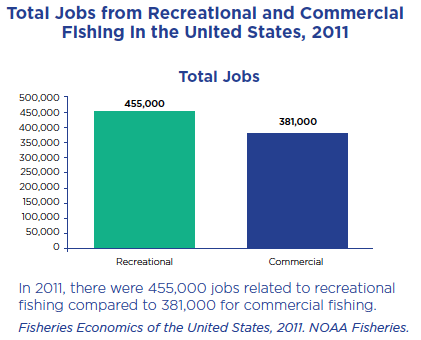
After all, marine recreational fishing contributes $70 billion annually to the nation’s economy and supports 454,000 jobs. It’s a pretty popular activity enjoyed by over 11 million Americans.
We have encouraged lawmakers to look to recommendations set forth by the Commission on Saltwater Recreational Fisheries Management, also known as the Morris-Deal Commission named after co-chairs Johnny Morris, founder of Bass Pro Shops, and Scott Deal, president of Maverick Boats.
Many of the Morris-Deal Commission priorities for the future of saltwater recreational fisheries were incorporated in the House-passed reauthorization (H.R.1335, the “Strengthening Fishing Communities and Increasing Flexibility in Fisheries Management” Act) that will give federal fisheries managers more authority to develop solutions that will take into account the special nature of recreational fishing.
The Senate recently held a hearing on MSA and is contemplating legislation. Our coalition of America’s ten leading recreational fishing and boating organizations signed a letter reminding leaders of the Senate Commerce Committee of areas where MSA needs improvement. Proposed improvements would uphold conservation while adopting management that is better suited to the nature of recreational fishing. The Commerce Committee staff welcomes our groups for conversation in the coming week. I believe it will be productive.