On May 5, the Atlantic States Marine Fisheries Commission (ASFMC) will make pivotal votes about the 2015 Atlantic menhaden quota and could begin work to change future management, including conservation and allocation decisions. The ASMFC could increase the quota for this year with no understanding of the impact on predators like striped bass, or managers could adopt ecosystem goals and advance responsible management of this most important fish in the sea. Managers should not increase the 2015 quota for menhaden unless they leave enough in the ocean as food for predators. Current quota shortages should be addressed by reallocation or trading, not by sacrificing coastwide conservation.
- A new stock assessment shows that coastwide Atlantic menhaden biomass (the combined weight of all fish) has increased in recent years after a steep decline in the 1990s.
- The stock assessment also finds that the actual abundance (number of fish) remains well below historic levels. This is what matters most to predators like striped bass.
- Recruitment (the number of fish surviving past 1 year) remains low.
- The menhaden population has not recovered throughout its historic range from Maine to Florida.
- Fishing effort is highly concentrated in the Chesapeake Bay and mid-Atlantic which risks localized depletion.
- See below for charts from the assessment showing biomass and abundance trends (Figure 1), then recruitment (Figure 2).
- On May 5, the Commission should adopt interim Ecological Reference Points (accounting for predator needs) when making decisions about the 2015 quota and initiate an amendment to transition to long term ecological management.
- Increasing the coastwide menhaden catch without consideration of the cost to predators would be irresponsible. Most menhaden predator populations are at best stable, and in many cases are declining.
- The Commission just made a difficult decision to reduce the striped bass catch to address a decline. Other Atlantic menhaden predators that are important for recreational and commercial fishing include highly-depleted weakfish, cod, and bluefin tuna. The Commission must provide enough food for these predator populations to rebuild and thrive, and avoid future quota cuts.
- Menhaden are also food for seabirds like osprey and eagles, and cetaceans like humpback whales which support ecotourism businesses. These wildlife species are economically important to Atlantic states.
- Consider the potential value that a growth in menhaden abundance would provide for the local seafood supply and associated jobs along the Atlantic coast. Why risk undermining broader conservation efforts?
- The time has come for managers to transition to ecosystem-based fishery management for Atlantic menhaden. In 2001, the ASFMC’s first amendment for menhaden included this objective: “Protect and maintain the important ecological role Atlantic menhaden play along the coast.”
- The new stock assessment’s peer review: “strongly encourages the [technical committee] and the Management Board to initiate a formal dialog, ideally inclusive of key stakeholder groups, to inform the development of Ecological Reference Points…to develop a common perspective among scientists, managers, and stakeholders about the strategy for defining reference points that reflect a broader ecological perspective on the Atlantic menhaden fishery…The [technical committee] has done a thorough job of investigating and summarizing the options. Now it is time for managers and stakeholders to guide the way forward.” (Review Workshop Report, page 27).
- The Commission should heed this call and act now to advance ecosystem management for this important forage fish.
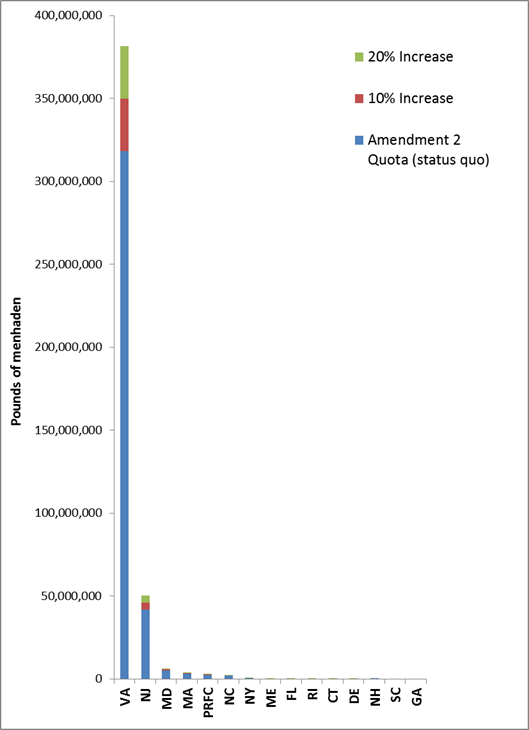
- All states stand to benefit from effective conservation, and only one would benefit significantly from increasing the quota in 2015 (Virginia). A proportional increase to the 2015 quota (for example, even the maximum proposed 20 percent increase over the 2014 quota for each state), without reallocation, will not solve any state’s quota shortages or bait industry challenges. See below for a chart that shows the quota by state if the proposed 10 or 20 percent increases occurred without reallocation. (Figure 3)
- The ASMFC should not risk the health of the coastal ecosystem to give nearly all of the increase to Virginia, which does not need an immediate quota increase.
- The reduction fishery (Omega Protein) has 80 percent of the coastwide quota and continued to be successful in 2014, the second year under the current catch limit.
- From their 2014 performance press release: “Revenues in the twelve months ended December 31, 2014 increased 26% to $308.6 million compared to revenues of $244.3 million for the twelve months ended December 31, 2013.” (link)
- Under the current (Amendment 2) management system, quota can be traded between states. Virginia could transfer a relatively small amount of quota and solve all other states’ current shortages without increasing the coastwide catch.
Figure 1: Biomass and abundance data for Atlantic menhaden from the most recent stock assesment.
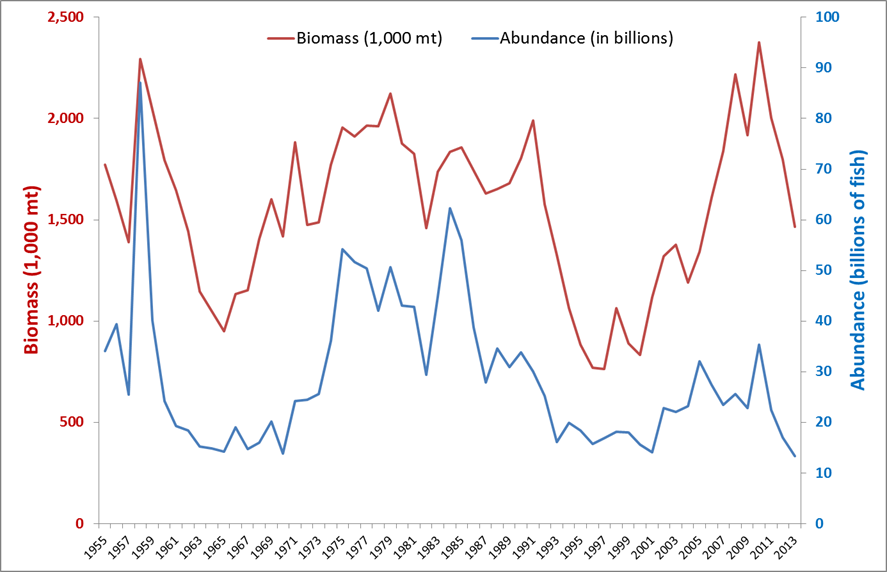
Figure 2: Recruitment (number of fish age one year and above) data for Atlantic menhaden from the most recent stock assesment.
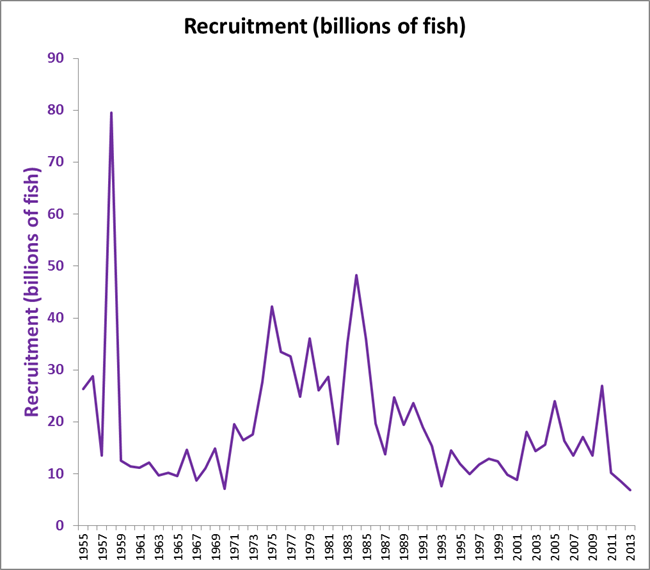
Figure 3: Quota by state with a hypothetical 10 or 20 percent quota increase without reallocation.